You may know dragonflies as big and eye-catching insects that soar through the summer skies, or you may know from our previous Creature Feature that they’re some of the greatest predators on the planet. But did you know that among them is one species so ferocious that it hunts its own kind? Its name is the dragonhunter!
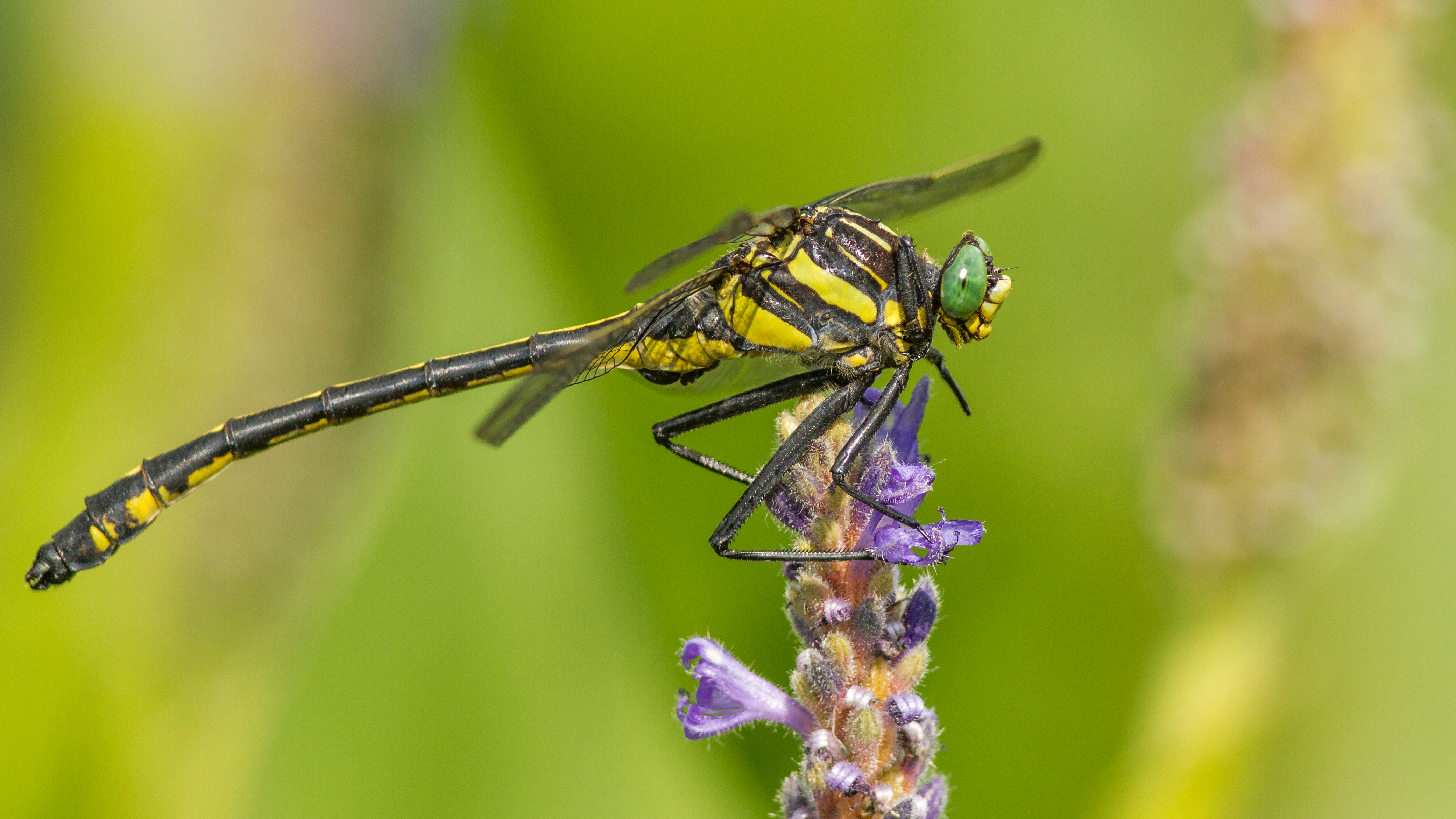
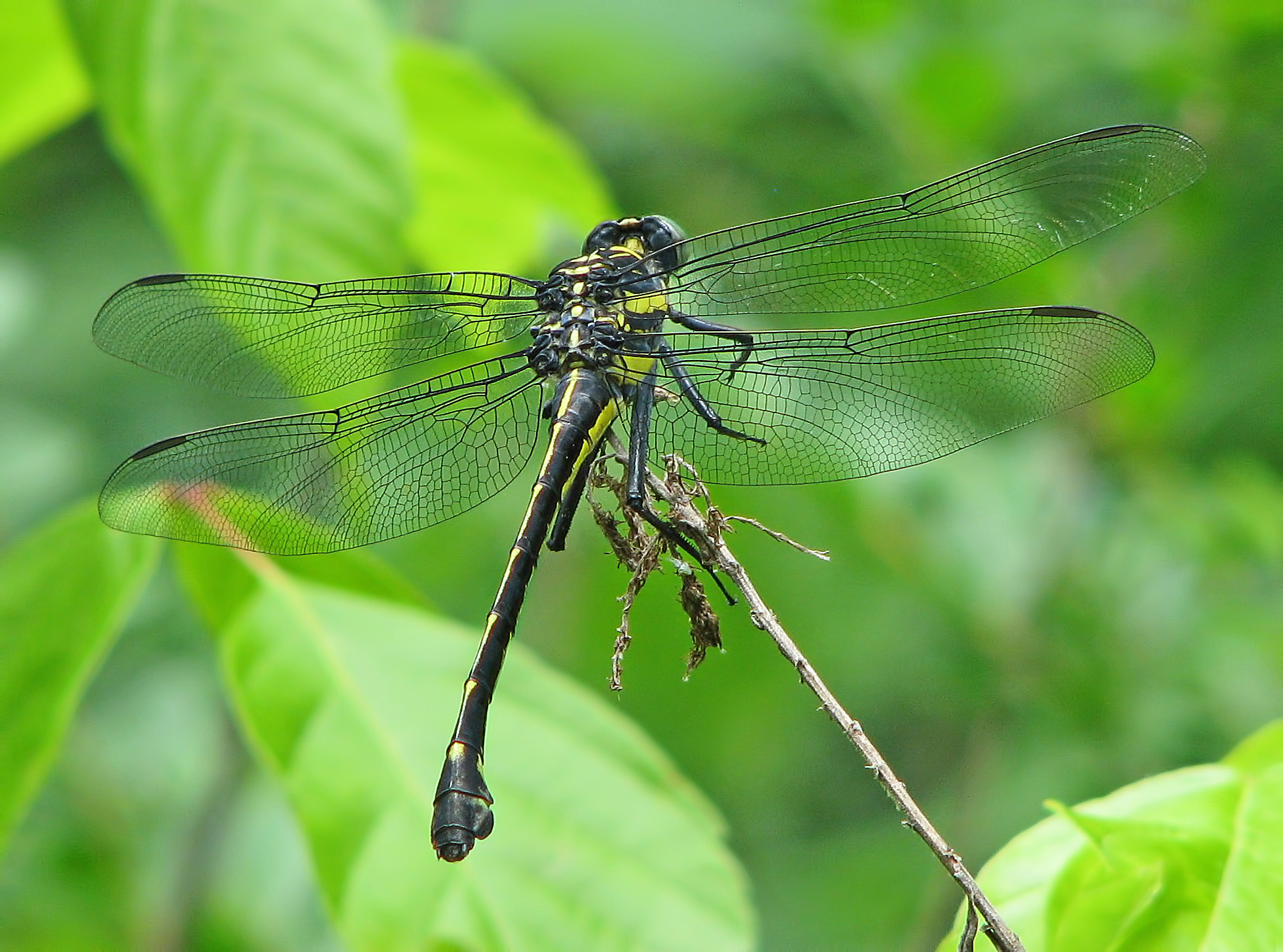
The dragonhunter, Hagenius brevistylus, is one of the largest species of dragonflies in North America, reaching up to 90 millimeters (or 3 ½ inches) in length [1]. It is in a group of dragonflies called the clubtails (family Gomphidae), named after the club-like shape at the end of the abdomen. As with most clubtails, these green and black striped dragonflies have eyes that do not touch at the top of the head, unlike those of other dragonfly groups. Adult male dragonhunters can be recognized by the slight downward “J” shape of their abdomen, which is more pronounced while in flight [1].
“Dragonhunter” is likely one of the scariest names among dragonflies. And it’s a name they live up to. Fellow odonates (a catch-all term for dragonflies and damselflies) make up most of their diet [1]. They are known to hunt larger prey as well, including monarch butterflies, and even hummingbirds [1, 2]! Though they hunt (arguably) the mightiest of predators, like any other dragonfly they do not pose any harm to human beings. They are not even among the dragonfly species that occasionally use us humans as perches.
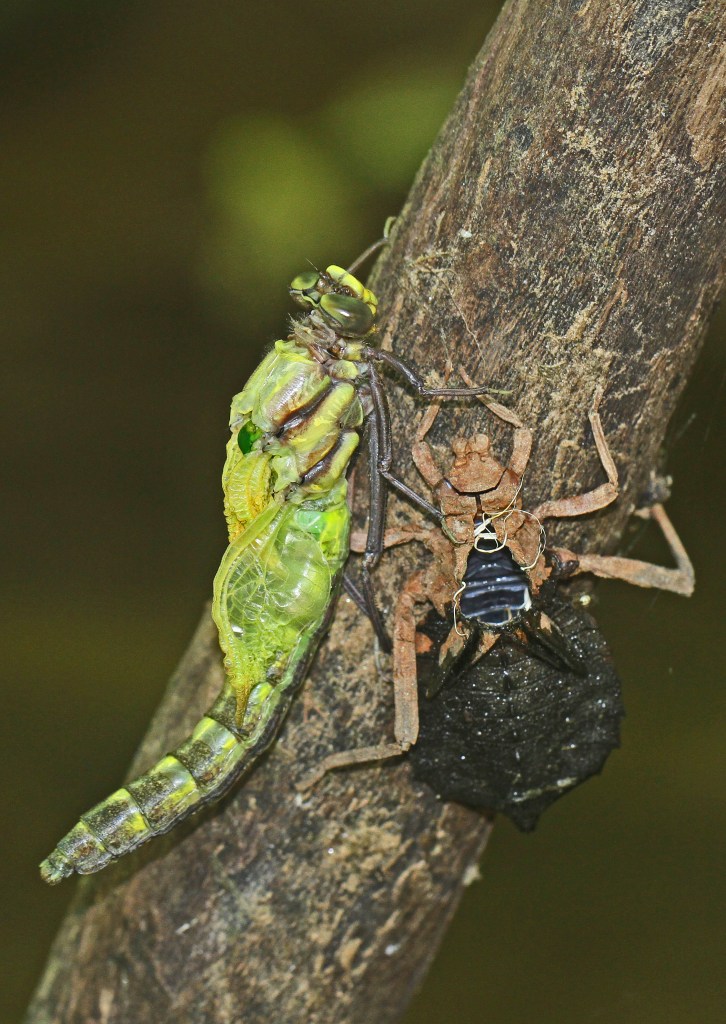
As larvae, all dragonflies look surprisingly different from their adult form, but dragonhunter larvae are especially unique. Their larvae are wide and flat, resembling the dead leaves you might find at the bottom of the rivers and streams they live in [3]. While this effective camouflage helps them look right at home among leaf litter and detritus, it comes with some additional, and perhaps unusual, consequences: zebra mussels have been known to attach themselves to the wide backs of dragonhunter nymphs [4]! Researchers at the University of Michigan found that dragonhunter nymphs were completely unable to right themselves when flipped over on their backs, probably due to their leafy shape. Furthermore, other species of dragonfly larvae that can normally flip over take longer to do so when mussels are attached to them [4]. While clearly not an ideal situation for the dragonhunters, the researchers also found that this isn’t something that happens too often. Thus, mussel hitchhikers are unlikely a major threat to these animals.

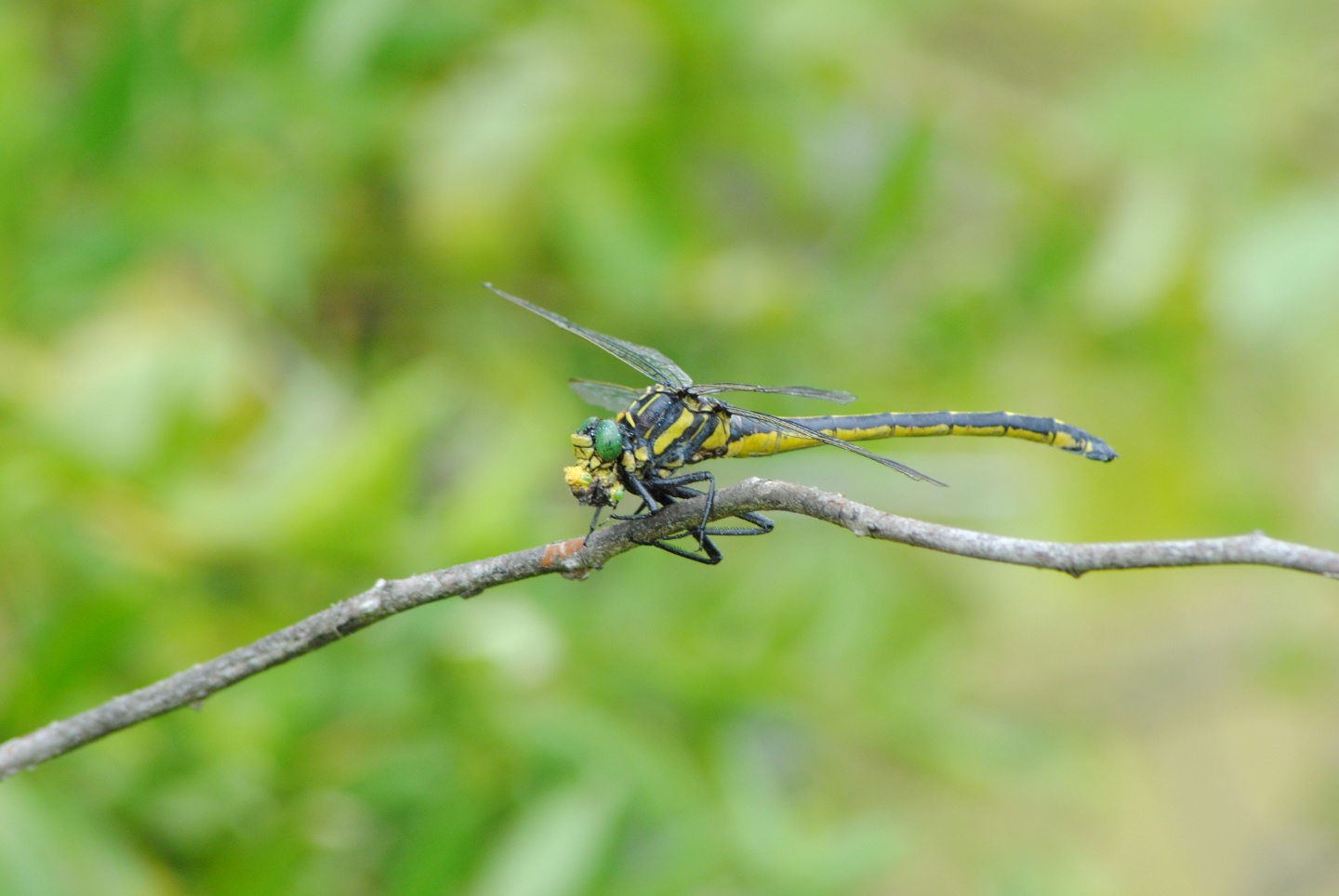
Dragonhunters are typically found along rivers in the eastern United States and southeastern Canada, where they hunt their prey from perches or during short flights [1, 5]. Peculiarly, they tend to approach their prey from above, whereas most other dragonflies grab their prey from below [3]. It is not completely clear why they differ in this way, but one possible reason has to do with how high their prey is often found. Damselflies in particular, which dragonhunters eat just as often as dragonflies, tend to perch on lower vegetation than their dragonfly cousins.
Dragonhunters are also known for their very awkward perching behavior. Their hind legs are much longer than those of most other species, which results in them resting horizontally, while other species rest vertically [1, 6]. The general thought about these longer hind legs is that they enable them to more effectively grasp their larger prey. This would be critical for them, seeing as other odonates, butterflies, and hummingbirds are certainly larger than the flies and mosquitoes that most other dragonflies feast on.
With an infamous name and impressive feats of capture, the dragonhunter is a well-admired insect by entomologists and odonatologists (scientists who study dragonflies) alike, but less so by their fellow dragonflies.
Christofer Brothers is a PhD candidate in the Animal Behavior Graduate Group. He currently studies prey capture behavior and functional morphology in both larval and adult dragonflies. Christofer spends his free time catching dragonflies, playing DnD, and making too many puns.
References
[1] Paulson, D. (2012). Dragonflies and Damselflies of the East (Vol. 49). Princeton University Press.
[2] White, D. S., & Sexton, O. J. (1989). The monarch butterfly (Lepidoptera: Danaidae) as prey for the dragonfly Hagenius brevistylus (Odonata: Gomphidae). Entomological news, 100(3), 129-132.
[3] Corbet, P. S. (1999). Dragonflies: behaviour and ecology of Odonata. Harley books.
[4] Kamps, A., Scieszka, C., & Westmoreland, B. (2018). Effect of body size and zebra mussel attachment on exuviae emergence-site selection in five dragonfly species (Hagenius brevistylus, Didymops transvera, Macromia illinoiensis, Dromogomphus spinosus, Epitheca). Working Paper, University of Michigan Biological Station.
[5] Silsby, J. (2001). Dragonflies of the World. CSIRO publishing.
[6] Tracy, C. R., Tracy, B. J., & Dobkin, D. S. (1979). The role of posturing in behavioral thermoregulation by black dragons (Hagenius brevistylus Selys; Odonata). Physiological Zoology, 52(4), 565-571.
[Edited by Alice Michel & Jacob Johnson]
 theethogram.com


