The sun has just risen and you’re standing on a Peruvian forest floor in a cloud of buzzing mosquitoes. You hear the wildlife around you waking up: frogs and toads are croaking, titi monkeys are singing their morning duets, a millipede skitters over dead leaves underfoot. The tree branches towering high above you seem to be blowing in the wind, but as you look up through the leaves you notice something moving. It’s a black ball of fur with a large bushy tail, walking nimbly through the branches like a cat. As it approaches a gap in the canopy, it leaps. With arms and legs spread out wide, it soars—you find yourself wondering whether the next branch can hold this creature’s weight. Watching quietly, you see it land safely, just as a sunbeam illuminates its face and distinctive hairstyle. Finally, you recognize what you see: a saki monkey!

Closely related to the red uakari seen in a previous Creature Feature, sakis (genus Pithecia) are among the weirdest looking animals in the Amazon Rainforest. Their fluffy tails are as long as their bodies. This helps them balance high up in the trees, where they spend most of their lives eating, socializing, and moving about. They can even leap through the canopy over narrow rivers! Sakis typically live in pairs, one male and a female, with their offspring, but sometimes other adults live with the pair [1].
Both male and female sakis have a thick fur coat that makes their small bodies look like big round blobs—to the point that they’re often mistaken for termite nests! Once you’ve ascertained that what you’re observing is not, in fact, a termite nest, the males and females are easy to tell apart by the hairstyles framing their faces: females have short, gray, bowl-like haircuts, while males have dark brown fur around the crown of their head and light cream-colored faces [2]. When male and female animals look different, it’s called sexual dimorphism. Sexual dimorphism exists across taxonomically distant animals and can be in ornamentation (e.g., male elk have antlers but females don’t), size (e.g., female raptors are bigger than males), or coloration, like these saki monkeys. Can you think of possible hypotheses as to why these differences might evolve?
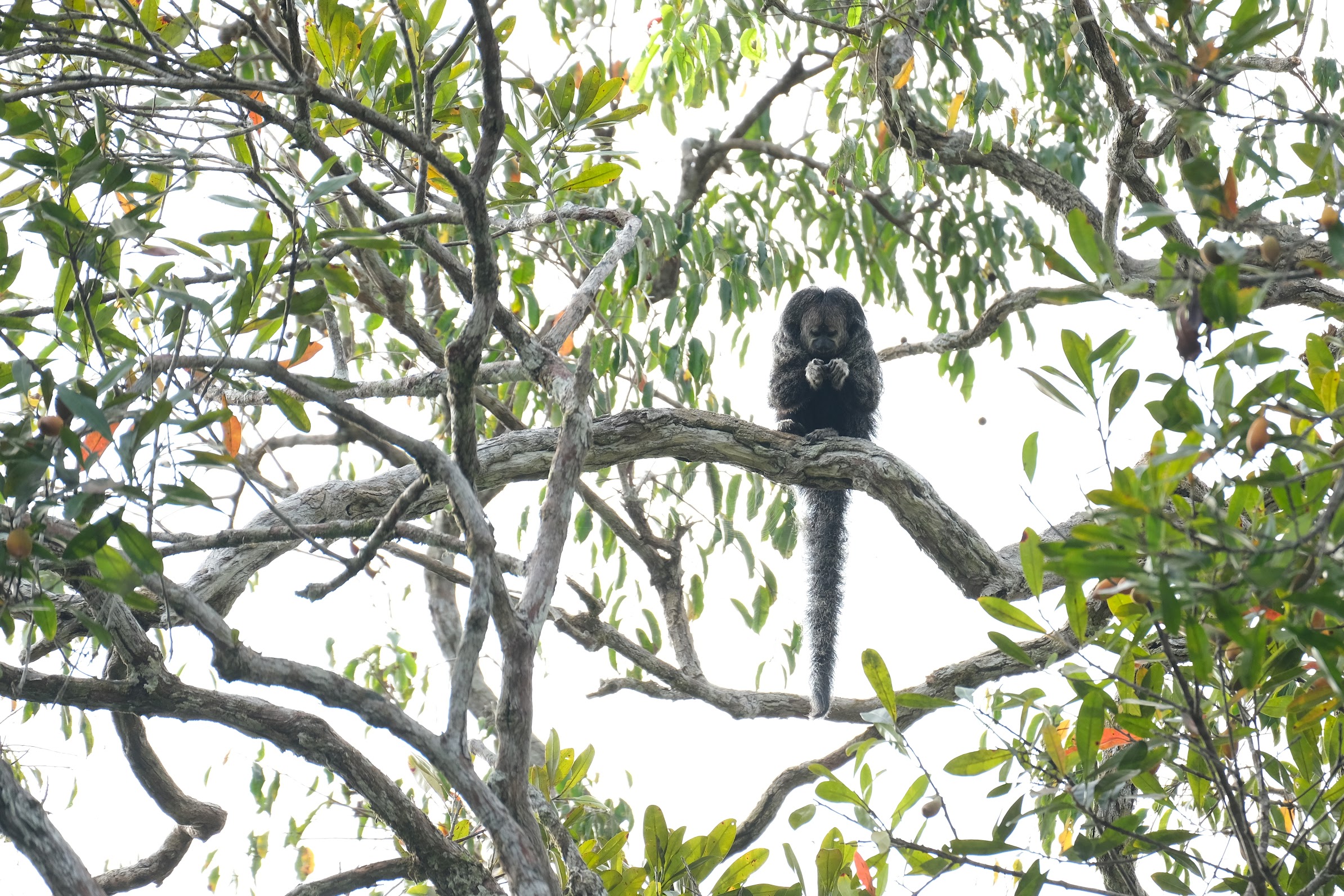
Not a lot is known about saki monkeys because, in addition to their unique and sometimes cryptic appearance, they are extremely shy. This makes it difficult for researchers to observe them before they leap away [3]. The best time to spot these skittish monkeys is after a rainstorm, when they’re sunbathing in the treetops to dry out their fur. If you hear something dropping down to the ground or splashing in the river below, it’s likely that they’re eating! Sakis primarily eat fruit, but their diets differ from those of most other Amazonian primates. Instead of eating the sweet and juicy pulp of fruits like we generally do, sakis throw the pulp to the ground after chewing and swallowing the large seeds inside. Because of this unusual feeding behavior, they’re often referred to as “seed predators” [4]. Sakis do sometimes eat fruit pulp, as well as leaves and insects, but the majority of their diet consists of seeds. This is thought to be an adaptation to unstable food availability in their frequently changing habitat of seasonally flooded forests [5,6].
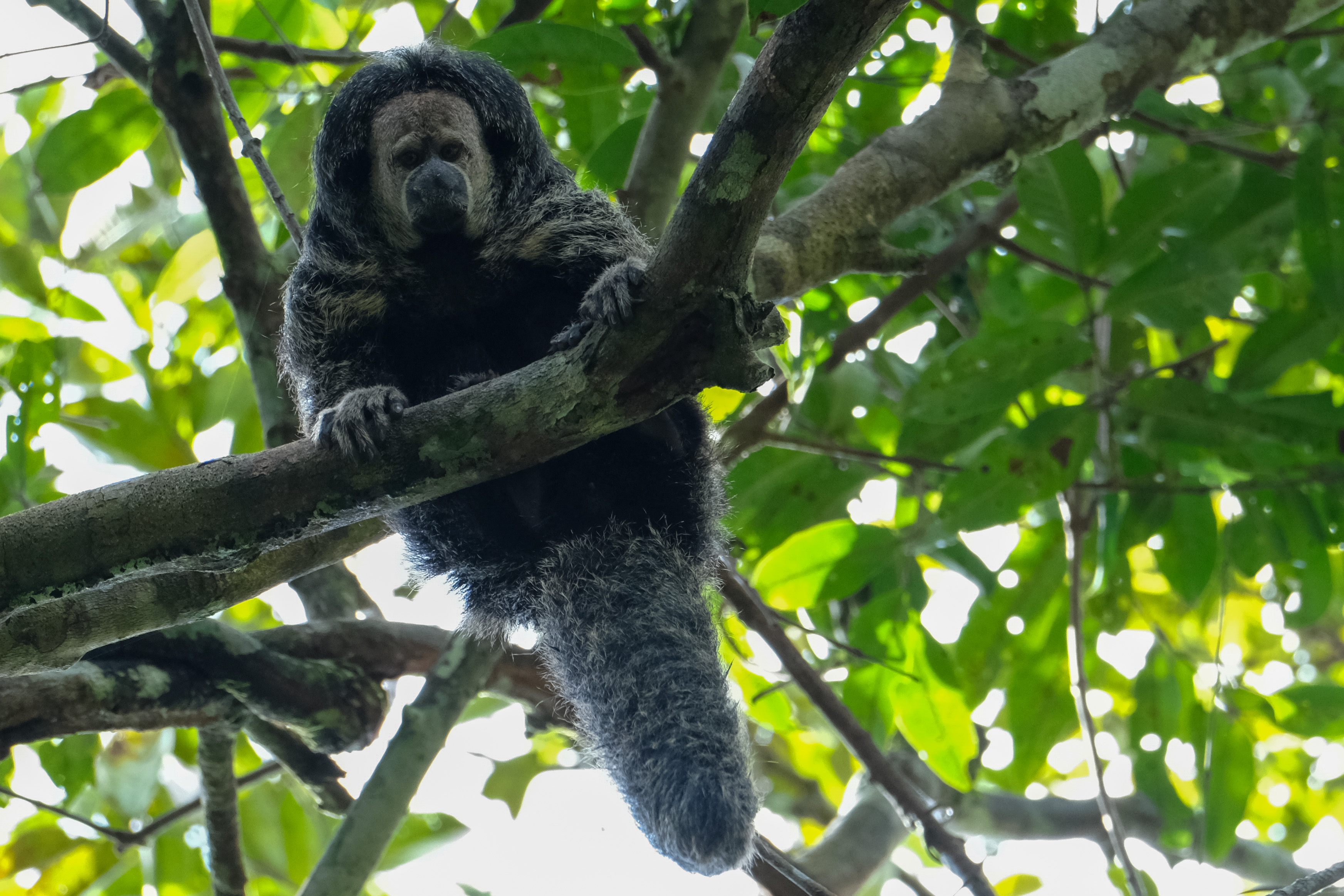
While saki monkeys are not considered endangered, they face hunting pressures that have contributed to substantial declines in some populations [7]. People often hunt sakis because their long bushy tails can be used like feather dusters, which suggests that working with communities to develop an alternative, non-animal-based tool for this purpose could be a relatively simple conservation solution. Indeed, in recent years, research and conservation efforts have decreased hunting of many Amazonian animals, including saki monkeys, allowing their population numbers to begin to recover. That means that anyone venturing into the rainforest who keeps their eyes and ears trained upwards has the chance to hear a saki’s chirping alarm call (hear it for yourself on YouTube) or spot a furry mass soaring from tree to tree!
Written by: Abby Morris is a PhD student in the Animal Behavior Graduate Group at UC Davis. She is interested in studying seasonal differences in gorilla movement and behavior. While Abby loves studying monkeys and apes, she also enjoys hiking around California to look for local wildlife!
References:
[1] Thompson, C. L. (2016). To pair or not to pair: Sources of social variability with white‐faced saki monkeys (Pithecia pithecia) as a case study. American Journal of Primatology, 78(5), 561-572.
[2] Marsh, L. K. (2014). A taxonomic revision of the saki monkeys, Pithecia Desmarest, 1804. Neotropical primates, 21(1), 1-165.
[3] Pinto, L. P., Barnett, A. A., Bezerra, B. M., Boubli, J. P., Bowler, M., Cardoso, N. D. A., … & Veiga, L. M. (2013). Why we know so little: the challenges of fieldwork on the Pitheciids. Evolutionary biology and conservation of titis, sakis and uacaris. Cambridge University Press, Cambridge, 145.
[4] Ledogar, J. A., Winchester, J. M., St. Clair, E. M., & Boyer, D. M. (2013). Diet and dental topography in pitheciine seed predators. American Journal of Physical Anthropology, 150(1), 107-121.
[5] Norconk, M. A., & Conklin-Brittain, N. L. (2004). Variation on frugivory: the diet of Venezuelan white-faced sakis. International Journal of Primatology, 25, 1-26.
[6] Norconk, M. A., Rosenberger, A. L., & Garber, P. A. (Eds.). (2011). Adaptive radiations of Neotropical primates. Springer Science & Business Media.
[7] Marsh, L.K. & Heymann, E. W. (2018). Pithecia aequatorialis. The IUCN Red List of Threatened Species 2018: e.T17402A17971831. https://dx.doi.org/10.2305/IUCN.UK.2018-2.RLTS.T17402A17971831.en. Accessed on 23 July 2023.
[Edited by Alice Michel & Jacob Johnson]
 theethogram.com