Picture this: you’re on a hike in the mixed conifer forests around Lake Tahoe in the Sierra Nevada. Ancient, resolute pines sway gently above you in the mountain breeze, dappling the sunlight around you. All is quiet besides the faint rustle of branches in the breeze and the crunch of needles under your boots. Suddenly, a fast, high-pitched chirping pierces the air, echoing against the surrounding mountainsides. As you continue walking, eyeing the canopy for the source of this clarion call, you also hear a scuttling of claws on tree bark. A small shadow flashes in the branches overhead. You are now face to face with the raucous ambassador of the forest: the Douglas squirrel.
Now, most of us might be familiar with the large gray squirrels that casually stroll through city parks and backyards. However, the squirrel family is a fairly diverse group of rodents, including chipmunks, marmots, prairie dogs, flying squirrels, ground squirrels, and tree squirrels [1]. The Douglas squirrel (also known as a chickaree or a pine squirrel) is one such tree squirrel, located in conifer forests that spread from southeast Alaska and British Columbia to the Sierra Nevada of California [2,3].
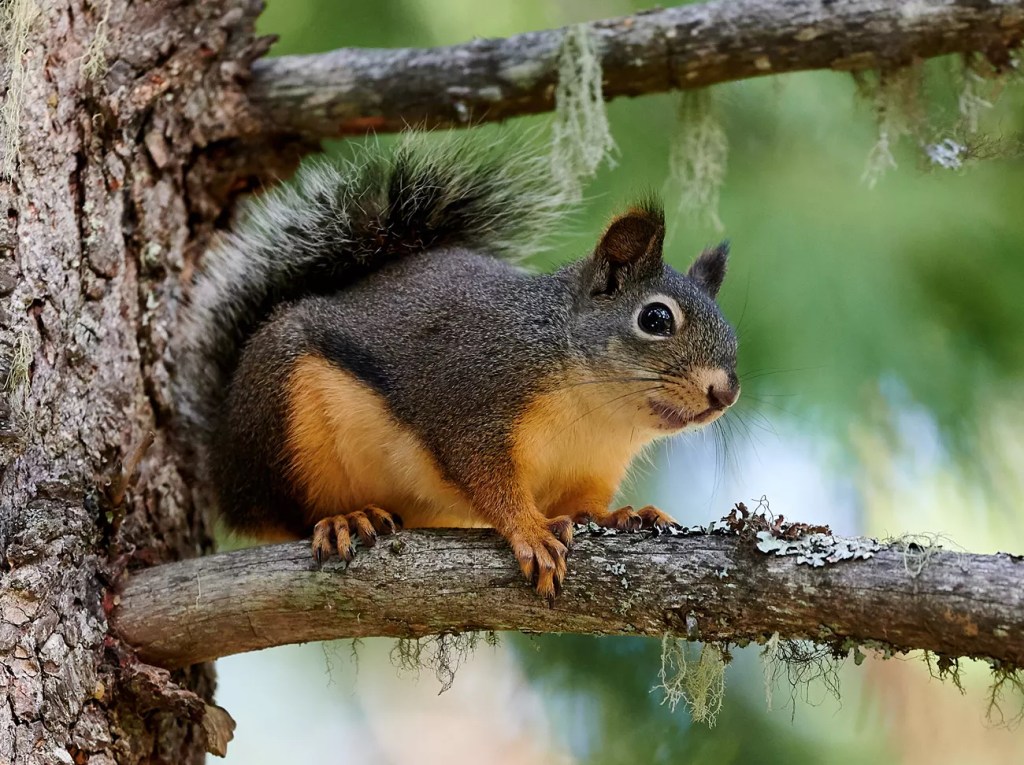
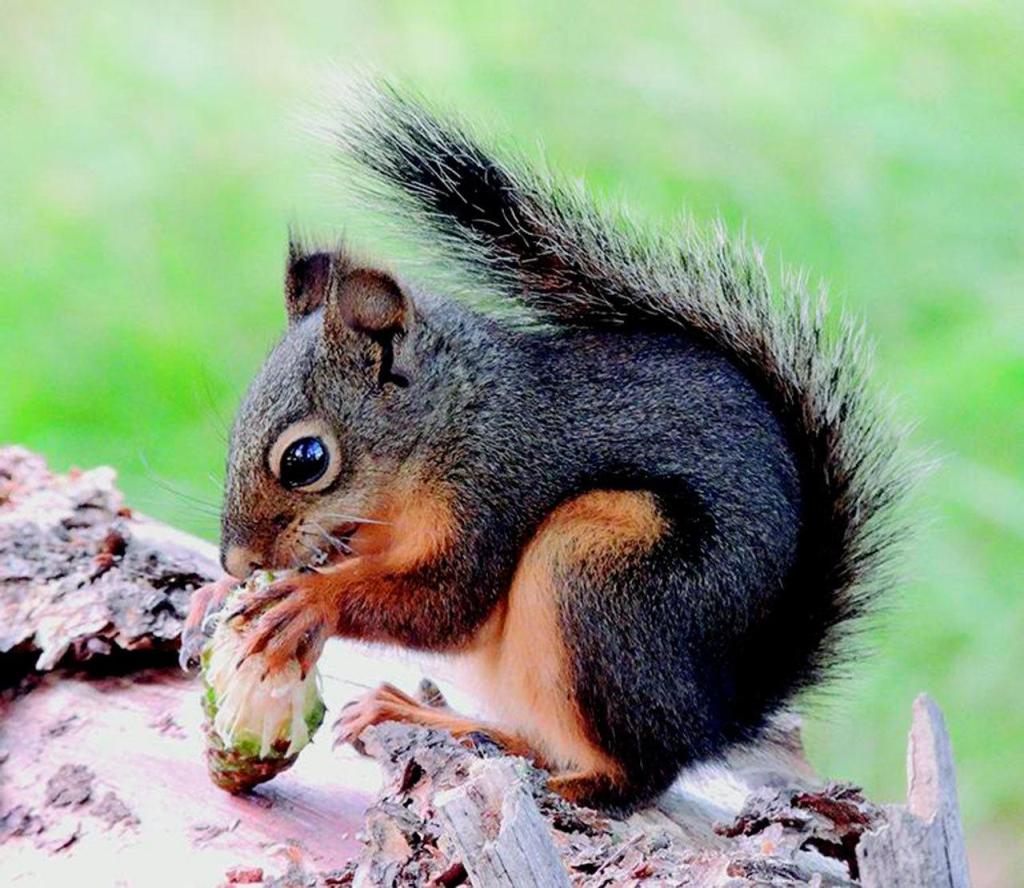
With a brownish-gray back and orange belly [2], Douglas squirrels are half the size (about 10-14 inches long, including their tails) of their more urban cousins and spend the majority of their time in the trees [2]. These arboreal squirrels are often heard before they’re seen and are famous for their loud, bird-like calls [4]. Naturalist John Muir even described them as “…the mocking-bird of squirrels, pouring forth mixed chatter and song like a perennial fountain; barking like a dog, screaming like a hawk, chirping like a blackbird or a sparrow; while in bluff, audacious noisiness he is a very jay.” [5]
The bombastic voice of the Douglas squirrel serves an important purpose: to protect their territory [2]. These squirrels spend most of their lives alone, ending their solitude only for mating, and for females, raising their young. They also spend a large amount of time during summer gathering and storing food in large caches underneath trees (a behavior known as larder-hoarding) to prepare for winter [5,6]. As such, they are very territorial, protecting their home areas by making different types of calls (rattling, screeching) [7] and by aggressively chasing or fighting with intruders [6].
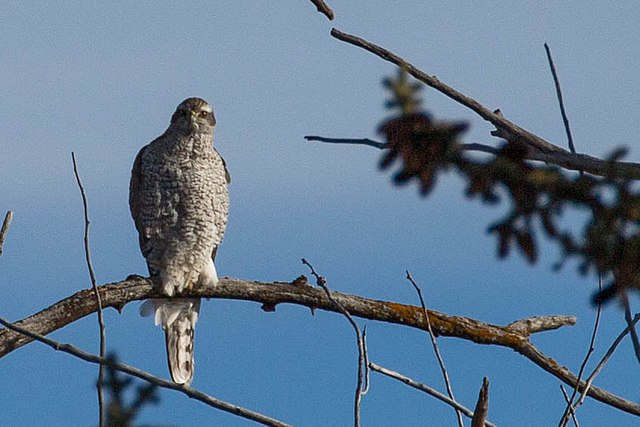
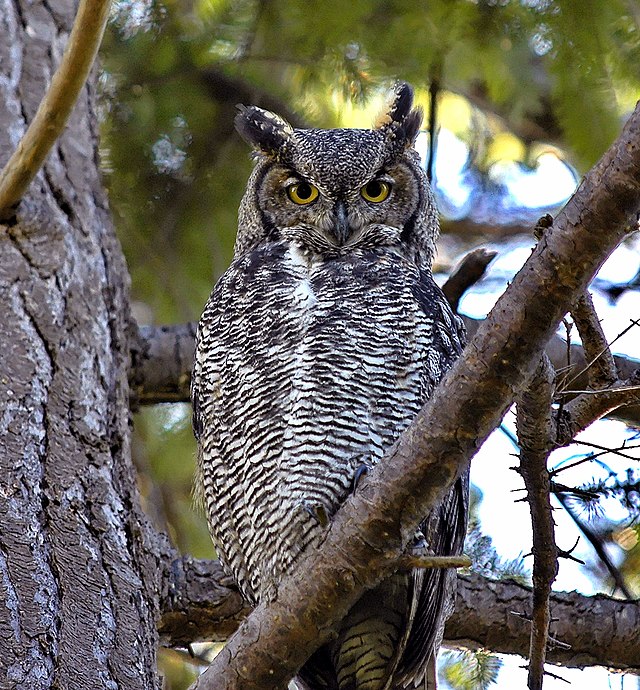
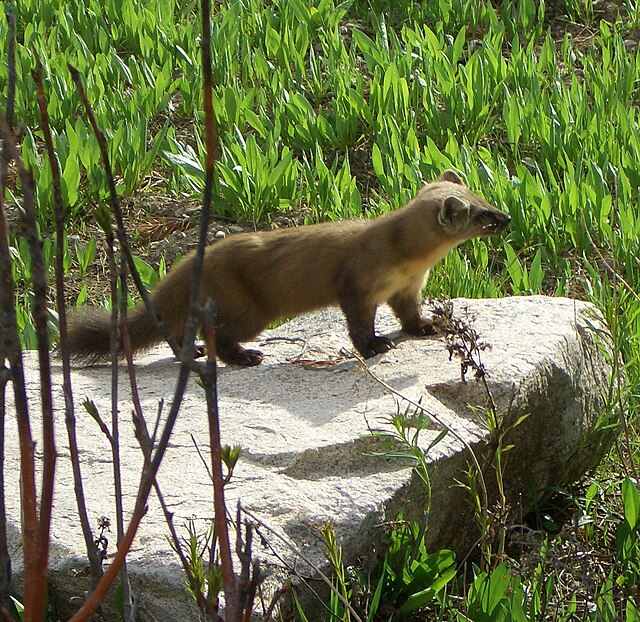
Douglas squirrels are preyed upon by a variety of animals, including goshawks, owls and martens (see below) [6]. To avoid being eaten, they dart quickly between trees, chirping aggressively for long amounts of time and vigorously flicking their tails to warn trespassers away [5,7]. Given their intense character, it is no wonder that these squirrels have spread across many forests from sea level to the high mountains.
The wide range of the Douglas squirrel can also be attributed in large part to their diet. While they primarily eat conifer seeds [2], these squirrels will happily eat anything, including mushrooms (such as truffles), insects, bird eggs, flowers, berries and sap [2,6]. They are voracious in their gathering activities, stockpiling food in their tree-trunk larders. The process of this larder hoarding is very different from more scattered hoarding of other squirrels: Douglas squirrels can cut large numbers of cones down from trees before storing them en masse [5,6]. Once they are ready to eat the seeds, they will pull cones out of storage and remove the seeds by breaking the cones open with their teeth [6]. While they are collecting cones, they will pick trees with the most nutritious seeds first and then collect less nutritious seeds in lower amounts [3].
Though squirrels eat many tree seeds, they also scatter them to sprout during eating or by forgetting the location of their caches. This enhances the dispersal (i.e. movement) and survival of seeds in the forest. Similarly, by digging up truffles and uprooting other mushrooms, Douglas squirrels spread fungal spores throughout the forest and ensure normal forest decomposition processes [6,9]. Thus, through all their interactions with plants, fungi and other animals, these fiery little creatures contribute to forest health. Be sure to keep an eye (or an ear) out for them on your next hike!
Feature photo by Franco Folini [Source]
Written by: Gillian E. Bergmann is a 4th year Ph.D. candidate in the Ecology Graduate Group at UC Davis. Working in the labs of Johan Leveau and Rachel Vannette, she studies how microbes disperse from watermelon flowers to seeds. She is also passionate about teaching microbial ecology via mentoring undergraduates in research and leading paper reading seminars. While her scientific pursuits are focused largely on plant-microbe interactions, Gillian spends much of her free time outdoors admiring animals, plants and mushrooms. An avid cyclist, she enjoys watching for birds, squirrels, bees and other wildlife while on the bike.
References:
[1] G. Musser, Squirrel | Types, Habits & Adaptations, Encycl. Br. (2023). https://www.britannica.com/animal/squirrel (accessed September 19, 2023).
[2] S. Daw, Douglas’s Squirrel (U.S. National Park Service), National Park Service, Ashland, Oregon, 2021. https://www.nps.gov/articles/000/douglas-s-squirrel.htm (accessed September 14, 2023).
[3] M. Steele, Tamiasciurus douglasii, Mamm. Species. 630 (1999) 1–8.
[4] Douglas Squirrel, BirdNote. (2012). https://www.birdnote.org/listen/shows/douglas-squirrel (accessed September 19, 2023).
[5] J. Muir, The mountains of California, The Century Co, New York, 1894.
[6] T. Butler, Natural History Dispatch: Life of the nimble Douglas squirrel, Sequim Gaz. (2016). https://www.sequimgazette.com/life/natural-history-dispatch-life-of-the-nimble-douglas-squirrel/ (accessed September 19, 2023).
[7] C.C. Smith, Structure and Function of the Vocalizations of Tree Squirrels (Tamiasciurus), J. Mammal. 59 (1978) 793–808. https://doi.org/10.2307/1380144.
[8] S.L. Lindsay, Geographic size variation in Tamiasciurus douglasii: significance in relation to conifer cone morphology, J. Mammal. 67 (1986) 317–325.
[9] S.D. SANDERS, Foraging by Douglas Tree Squirrels (tamiasciurus Douglasii: Rodentia) for Conifer Seeds and Fungi, Ph.D., University of California, Davis, 1983. https://www.proquest.com/docview/303132346/abstract/36DEAE96FE7240ADPQ/1 (accessed September 14, 2023).
[Edited by Jacob Johnson and Alice Michel]
 theethogram.com
.jpg)

