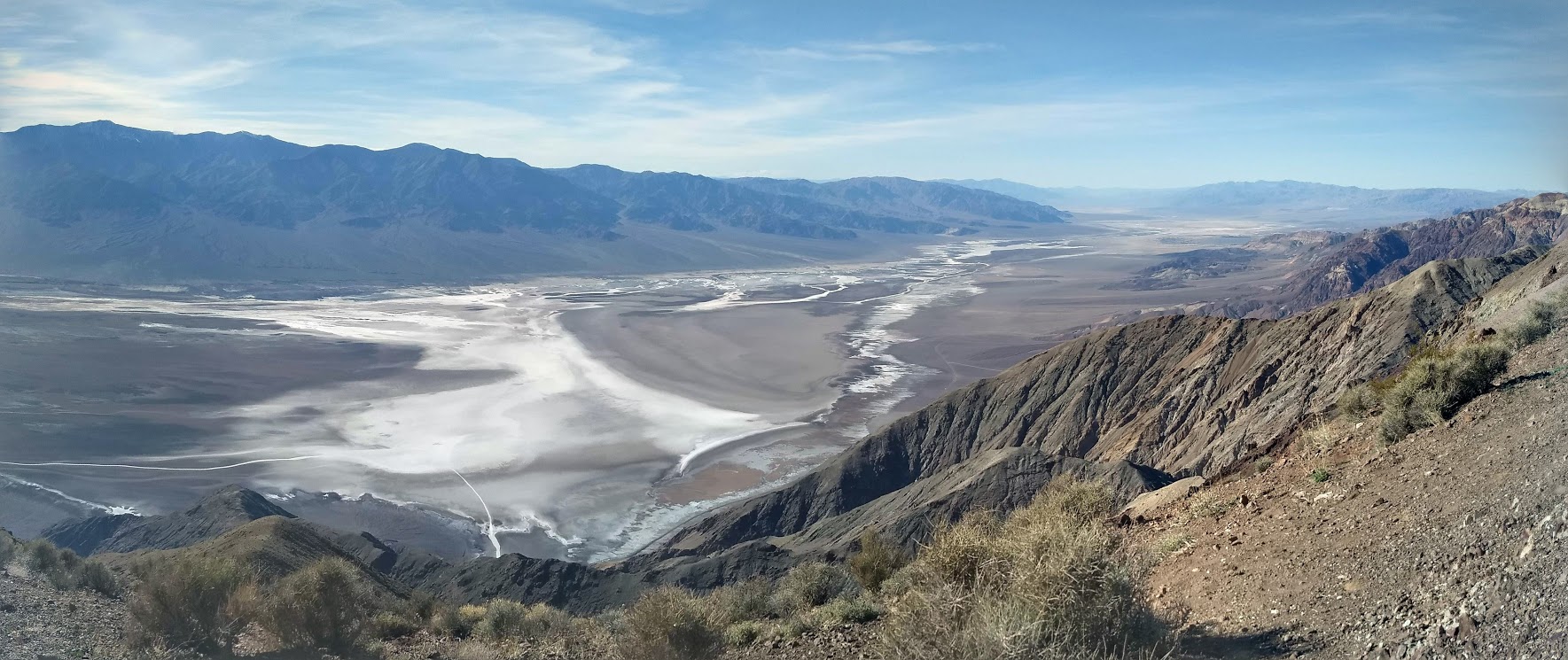
When my Desert Ecology class visited Death Valley, California, in the summer of 2018, I figured that this must be what it would feel like to be a loaf of bread baking in the oven. We saw yawning bleached-white canyons, sun-scorched salt flats with spiderweb-like cracks in the ground: all manner of landscapes that looked inhospitable to life. The giant thermometer in the national park parking lot flashed 124 ˚F (or 51 ˚C) that day—still a ways off from Death Valley’s (and the world’s) heat record of 134 ˚F (57 ˚C). It was hard to imagine how any animal could eke out an existence here…
Let alone a fish.
And yet, Death Valley is home to several species of fish found nowhere else: the Death Valley pupfish. Researchers have placed the pupfish of Death Valley into several groups of species and subspecies, including the Salt Creek Pupfish (Cyprinodon salinus), the Amargosa Pupfish, (Cyprinodon nevadensis), and the Devil’s Hole Pupfish (Cyprinodon diabolis). These tiny desert-dwellers, each no longer than your pinky finger, are specialists for this seemingly rough life, descendants of fish from a much more hospitable time.

One-hundred and fifty thousand years ago, during the relatively chilly Pleistocene, Death Valley was a lake. Conditions in and around Lake Manly, which stretched over 100km across and 200m deep, were warm and lush, an ideal habitat for many different fish species. At the end of the Pleistocene some 10,000 years ago, however, the climate became hotter and drier, and year by year, that lake began to vanish [1]. The tiny and resilient pupfish found refuge in the sparse streams and ponds that remained, scattering their populations like sailors marooned on watery islands [2]. Their rapidly changing environments encouraged these fish to relatively rapidly evolve some extreme lifestyle changes.
Over thousands of generations, the harsh desert has shaped Death Valley pupfish into impeccable survivalists. Deserts fluctuate wildly between blazing heat and bitter cold depending on the time of the day and the season. Many pupfish live their year-long lifespans in waters that can range from near freezing to over 100 ˚F [3], with salinity levels over four times that of our oceans. These hardy fish can’t afford to be picky with their food, either—eating small insects, algae, and any other detritus they can get their mouths on. The unpredictability of desert resources means that their population sizes also change rapidly, booming and crashing with the abundance of food and water [4].
The name “pupfish” comes from observers who found the fish’s behavior friendly, almost puppy-like [5]. This doesn’t stop them from getting aggressive during the breeding season. When it’s time to find a mate, some male pupfish will claim a spot of turf, defending it from would-be intruders and chasing them off with an angry nip. Other fish are more lovers than fighters, spending their energy looking for mates instead of challenging the competition. The frequency of these different strategies can change with the surroundings. For example, some pupfish populations in environments with more wildly-changing temperatures seem to get more aggressive and competitive [1]. Could changing conditions be favoring different strategies?
This is a phenomenon that researchers call “plasticity” – when an animal changes its characteristics in response to cues from its surroundings. Some individuals and species have more plasticity—more capacity to change themselves—than others. The ever-shifting conditions of Death Valley seem to give pupfish plasticity in spades.

Devil’s Hole Pupfish can only be found within a small watery desert cavern in Death Valley. As such, the species is critically endangered, containing only a few hundred to a few dozen individuals in any given year. Devil’s Hole Pupfish have traits that make even the adult animals look like small fry, including an oversized head, bulging eyes, and a stunted body [1]. When researchers reared other Death Valley pupfish under conditions similar to those in Devil’s Hole, with scarce food and constantly high temperatures, they found that the fish that developed looked very similar: a striking example of how environment influences appearance [6].
In recent decades, a community of researchers and conservationists have rallied to protect pupfish from threats to their habitat, such as humans pumping water from the aquifers they closely rely on for ranching and agriculture [7]. Pupfish are amazing examples of how our environments can shape us, both in the long haul of millennia and at the breakneck pace of daily life. They are also a powerful story of resilience. Even in the hottest place on Earth, there are fish that swim to the occasion.
[Cover image of Devil’s hole pupfish (C. diabolis) by Olin Feuerbacher / USFWS]
Written by: Jacob Johnson is a fourth-year animal behavior PhD student at UC Davis studying how animals respond to rapid environmental changes. When he’s not out chasing birds, he enjoys playing jazz saxophone, running board game nights, and writing about nature. His first book, Are You There God? It’s Me, Darwin, will be available later this year.
References:
[1] Lema, S. (2008). The phenotypic plasticity of Death Valley’s pupfish: Desert fish are revealing how the environment alters development to modify body shape and behavior. American Scientist, 96(1), 28–36. https://doi.org/10.1511/2008.69.3668
[2] Duvernell, D. D., & Turner, B. J. (1999). Variation and Divergence of Death Valley Pupfish Populations at Retrotransposon-Defined Loci. Molecular Biology and Evolution, 16(3), 363–371. https://doi.org/10.1093/oxfordjournals.molbev.a026117
[3] Shrode, J. B., & Gerking, S. D. (1977). Effects of Constant and Fluctuating Temperatures on Reproductive Performance of a Desert Pupfish, Cyprinodon n. Nevadensis. Physiological Zoology, 50(1), 1–10.
[4] Hammerson, G. (2011). Cyprinodon salinus | NatureServe Explorer. https://explorer.natureserve.org/Taxon/ELEMENT_GLOBAL.2.103079/Cyprinodon_salinus
[5] Rivard, K. (2023). The Extraordinary Lives of Death Valley’s Endangered Devils Hole Pupfish. National Park Foundation. Retrieved January 21, 2024, from https://www.nationalparks.org/connect/blog/extraordinary-lives-death-valleys-endangered-devils-hole-pupfish
[6] Lema, S. C., and G. A. Nevitt. 2006. Testing an ecophysiological mechanism for morphological plasticity in pupfish and its relevance for conservation efforts for endangered Devils Hole pupfish. Journal of Experimental Biology 209:3499-3509.
[7] Bracelin, J. (2022, May 12). Two Fish, Less Fish? Save the Pupfish! University of Nevada, Las Vegas. https://www.unlv.edu/news/article/two-fish-less-fish-save-pupfish
[Edited by Alice Michel]
 theethogram.com
