Pretend you haven’t read the title. What does this sound like to you?
I would never have guessed this deep, rumbling noise came from a reptile. Aside from geckos’ high-pitched chirps, most reptiles, like snakes and lizards, don’t use sound all that much [1]. However, technically, “reptile” isn’t a biological group, because birds, whom we don’t often consider to be reptiles, are more closely related to crocodiles and alligators than other “reptiles” like lizards and snakes. Their relatively recent shared evolutionary history with birds might explain why crocodilians have quite the vocal repertoire [2].
The African dwarf crocodile (genus Osteolaemus) weighs in at a scrawny 70 pounds and 5.5 feet long at most. They are darker gray in color than most crocodilians and have yellowish patches, which helps them blend into the canopy-covered rainforests of equatorial Africa from The Gambia through DRC where they live [3]. Unlike their 15-feet long/1,000-plus-pound better-known relatives, such as the saltwater crocodile and American alligator, dwarf crocodiles are nocturnal. They pass their days hidden in tangled root hideouts in swamps and forest pools or burrows [3].
It’s after dusk that their eerie, presumably long-distance vocalizations can be heard, droning in and out amongst the tropical swamp symphony of calling crickets, ribbiting frogs, and clucking bats [4].

The sound linked at the top of this post is called a ‘moo’, because, well, listen to it. Dwarf crocodiles make three other types of sounds, called ‘drums’, ‘rumbles’, and ‘gusts’ (listen below or here) [4].
All known African dwarf crocodile vocalizations are low-frequency [4]. Low-frequency sounds travel further than high-frequency sounds because they aren’t as easily blocked by physical structures. The low-frequency rumble of a distant car motor starting up is way easier to hear than a high-pitched bird chirping at the same loudness. The same way that a larger drum sounds lower, larger-bodied animals have an easier time making lower-frequency sounds. Dwarf crocodiles are probably communicating with each other over relatively long distances, to compete or advertise their body size to others, including females [2, 5]. It’s not yet known if vocalizations are associated with courtship or nest-making, which occurs 2-3 months after mating [6].
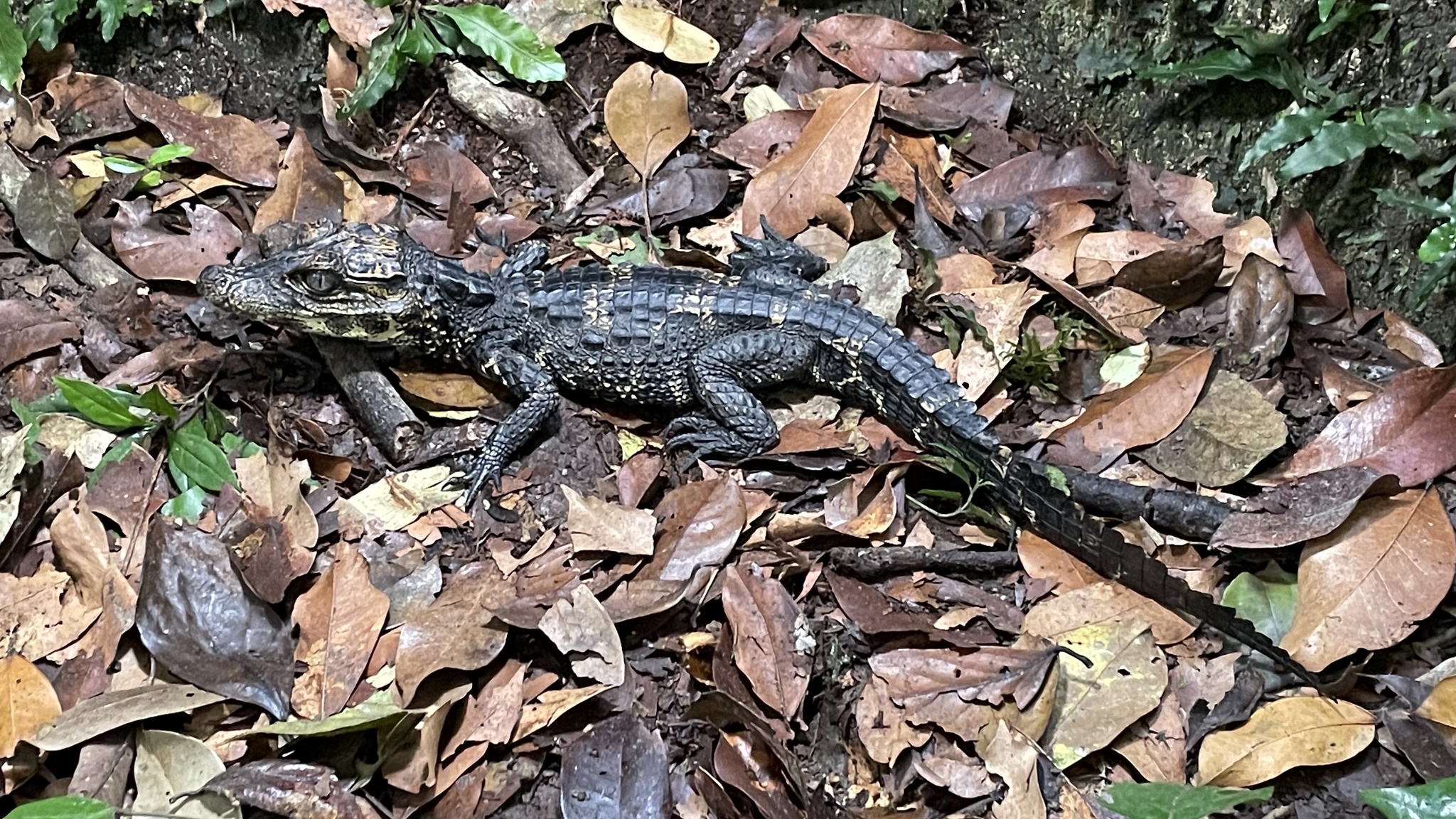
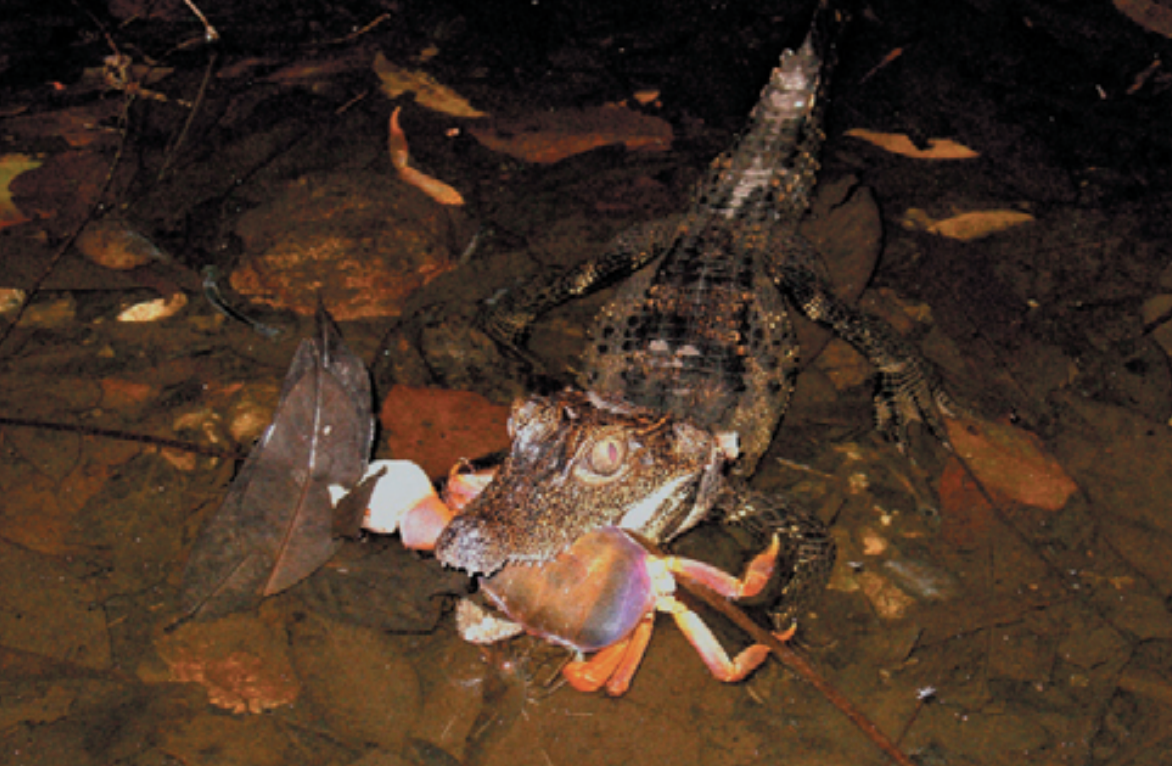
For that matter, it’s not known when or even how many times dwarf crocodiles nest during the year, though by talking with local hunters it seems that in some places they might have multiple clutches in a year [3]. Female dwarf crocodiles build mounds out of vegetation on which they lay their eggs. Each clutch has about a dozen eggs, and the mother sticks around to care for her hatchlings at least for a while. Like their breeding patterns, dwarf crocodile diets vary according to where exactly they live and the season. In general, they eat small animals like snails, crabs, insects, frogs, and fish, and rarely birds and small mammals [3]. Dwarf crocodiles are opportunistic predators and also feed on carrion, such as fish caught in fishermen’s nets.
Dwarf crocodiles are relatively abundant throughout the swamps and moist forests of western to central African rainforests. However, they are listed as vulnerable by the IUCN and a major target of bushmeat hunting. This has historically been driven by subsistence hunting at the local level [3]. However, the pressure put on tropical wildlife populations, including dwarf crocodiles, is likely reaching unsustainable levels due to increasing transitions to urbanization, a growing demand for bushmeat internationally (News article – warning: slightly graphic photo), and habitat loss and climate change. As alluded to above, there is a lack of biological and ecological information about African dwarf crocodiles, and more research into their basic ecology and behavior is critical to developing effective conservation mitigation plans [3].
Cover image: West African dwarf crocodile (Osteolaemus tetraspis) in Gabon. Photo by Barna Takats [Source].
Written by: Alice Michel is a fourth-year Animal Behavior PhD student. She studies how social behavior influences animal movement patterns. When she’s not recording gorillas in the swamp forest, she enjoys spending time in the sun.
References
[1] Brumm, H., & Zollinger, S. A. (2017). Vocal plasticity in a reptile. Proceedings of the Royal Society B: Biological Sciences, 284(1855), 20170451. https://doi.org/10.1098/rspb.2017.0451
[2] Vergne, A. L., Pritz, M. B., & Mathevon, N. (2009). Acoustic communication in crocodilians: From behaviour to brain. Biological Reviews, 84(3), 391–411. https://doi.org/10.1111/j.1469-185X.2009.00079.x
[3] Eaton MJ. 2010. Dwarf Crocodile: Osteolaemus tetraspis. Crocodiles. Status Surv. Conserv. Action Plan. 127–132.
[4] Staniewicz, A., McCabe, G., & Holderied, M. (2023). The low-frequency vocal repertoire of adult African dwarf crocodiles. African Journal of Herpetology, 72(2), 103–118. https://doi.org/10.1080/21564574.2023.2237035
[5] Dinets, V. (2013). Long-Distance Signaling in Crocodylia. Copeia, 2013(3), 517–526. https://doi.org/10.1643/CE-12-125
[6] Waitkuwait, W. E. (1989). Present knowledge on the West African slender-snouted crocodile, Crocodylus cataphractus Curvier 1824 and the West African dwarf crocodile, Osteolaemus tetraspis Cope 1861. Crocodiles. Their Ecology, Management and Conservation. A Special Publication of the IUCN-SSC Crocodile Specialist Group. Gland, Switzerland: IUCN.
[Edited by Jacob Johnson]
 theethogram.com