In semiarid central and southern Argentina, there lives a large, enigmatic rodent species. European explorers, writing in English, once called the animal the Patagonian Cavy or Patagonian Hare, but it is better known today by its local name, the mara [1]. Maras (scientific name Dolichotis patagonum) are endemic to Argentina, meaning they are only found there. While maras are not that rare to see, scientists still know little about them — somewhat of a trend in Creature Features of late! [2,3]. Maras are generally found in dry regions of Argentina, preferring dry open grasslands, also called steppes, as well as shrub and semi-open grasslands [4,1].
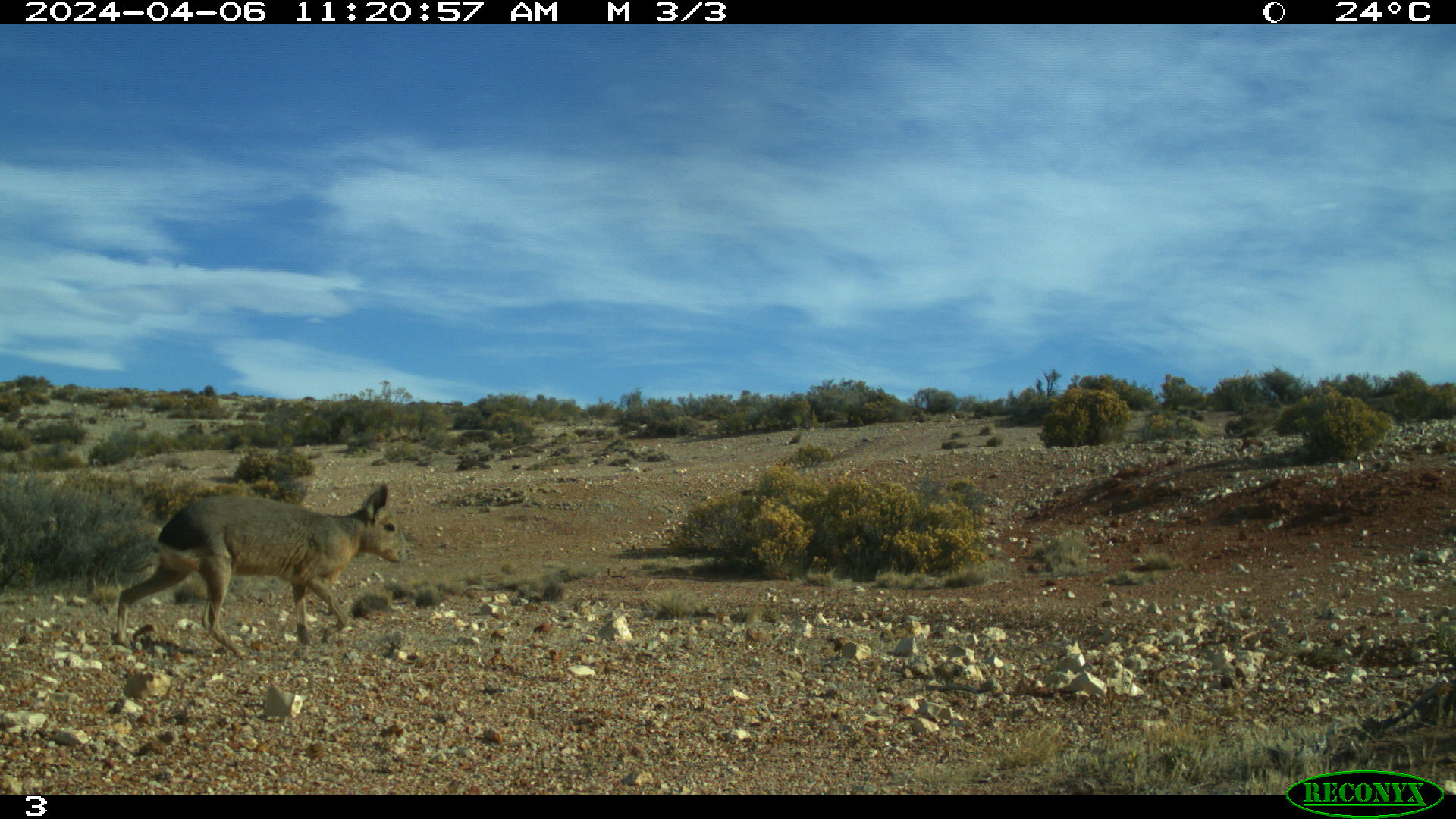
Weighing an average of 8-16 kg, the mara is the largest rodent species in southern Argentina, a region that, together with southern Chile, comprises Patagonia [1,5]. Within Argentina, maras are most commonly found in the country’s Patagonian provinces [3]. Similar to lagomorphic animals, like hares and rabbits, maras have powerful hind legs, and their posterior is wider than their chest, with a short, stumpy tail [1]. Both male and female maras have large eyes, long ears, and long legs with strong claws, with no significant difference in size between sexes [1,4]. Like many other mammals in these parts of Argentina, maras have short, thick fur colored dusty light brown-red-gray for camouflage in their environment [3,4].
Maras are considered diurnal animals, meaning they are most active during the day [3]. They are generalist herbivores, meaning they spend their days foraging for a variety of plants, depending on seasonal and habitat availability [2]. They prefer grasses above all but will supplement their diet with shrubs and forbs (herbaceous, non-grass plants) during droughts and drier summer and fall months [6].
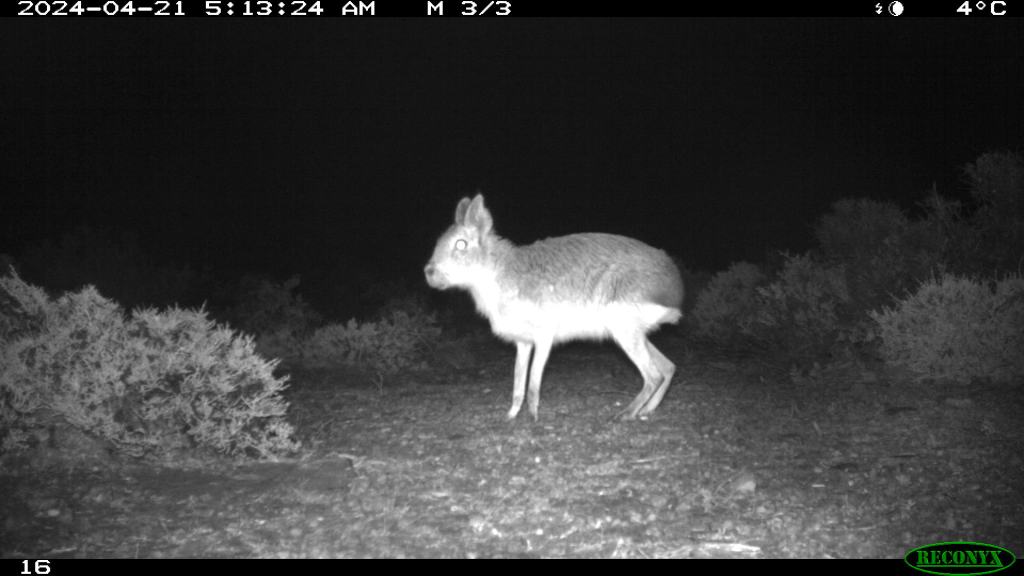
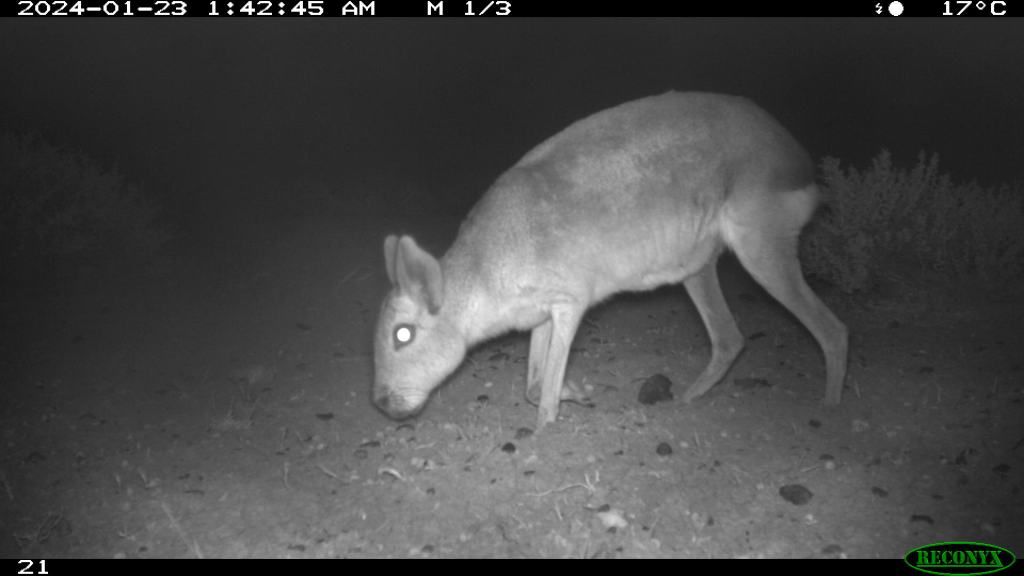
Maras are highly social animals, sometimes living in groups of up to 70 individuals [1]! Maras are monogamous, and mara female and male pairs are nearly always sighted within a few meters of each other [1,5,7]. It is the female who tends to determine the movements of the pair, with the male following behind while consistently scent marking near their partner with scat and anal secretions to warn off possible male competitors [1,7].
In northern parts of its range maras reproduce 1-2 times a year generally between spring and summer, while in Patagonia maras only reproduce once annually in the spring [3,7]. Maras reach sexual maturity at around 8 months of age and give birth to 1-3 pups that stay with their parents at least 1-2 months [3]. Maras dig communal dens, and their territory generally does not extend farther than a couple of kilometers away from these dens, especially when pups are young [1,7]. When pups are young, maras pairs group with other pairs together as a colony and take turns watching everyone’s pups, allowing parents go out to feed [1]. Maras abandon their den once the pups are old enough to run, either returning to the same den or digging a new den in the next reproductive season [7].
Mara dens are known for their elaborate structure and depth, some containing tunnels of up to 50m in length and almost always containing multiple entrances [4]! Mara dens are therefore important sources of shelter during times of inclement weather and winter months for several other species, including vizcachas (also known as chinchillones), armadillos, skunks and other rodents [4]. For this reason, maras are considered to be ecosystem engineers by many Argentine biologists [4].
There are no reliable estimates of mara numbers in Argentina, though many biologists suspect that mara populations have declined by up to 30% in only the last 10 years [1]. This is suspected to be due to the expansion of human activities. Maras overlap in dietary preferences with invasive and introduced domestic species – namely the European hare (Lepus europaeus) and domestic and feral horses and sheep – which some people believe contributes to mara population decline in many parts of Patagonia in particular [3,6,8]. In addition, maras are often hunted for their meat and sometimes taken from the wild as pets, which may also be contributing to population decline [3]. Finally, habitat fragmentation and degradation due to sheep ranching and increasing urbanization is believed to contribute to the decline of numerous native Patagonian wildlife species, including the mara [3]. However, because the species is highly adaptable, scientists and conservationists are hopeful that as more areas are conserved and protected, and hunting regulation is improved in Argentina, their numbers can recover [3].
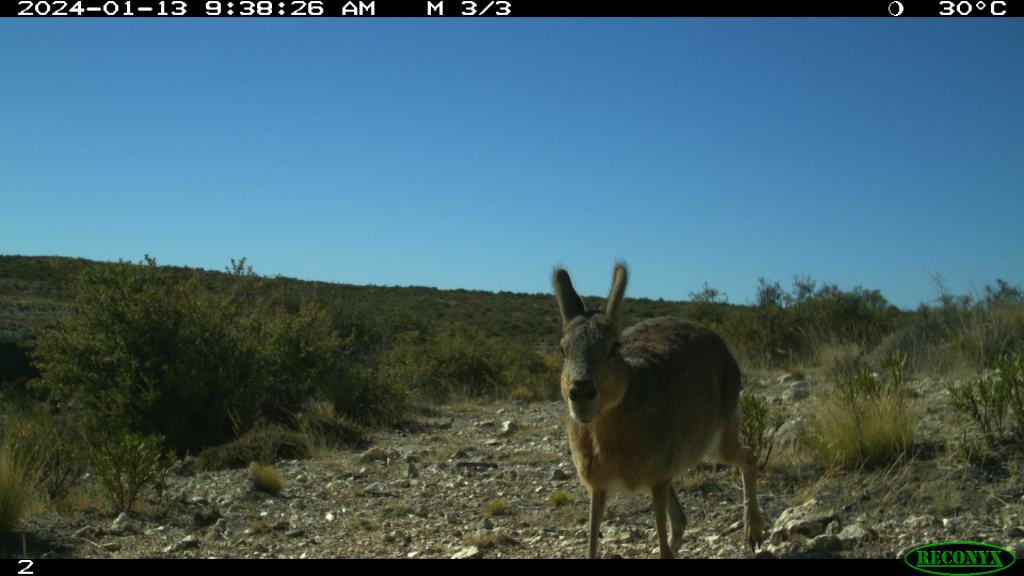
[Photo by Olivia Feldman]
Written by: Olivia Feldman is a PhD candidate in Justine Smith’s lab at the University of California – Davis. Olivia researches how wildlife, livestock and people interact in Argentina’s Patagonia region, and how these dynamics shape human-wildlife conflict. Having grown up and worked in Latin America and South Asia where people, livestock and wildlife all share space, Olivia is passionate about integrating people into how we study wildlife to improve conservation outcomes for both. All videos and photographs here are her own, taken during research conducted in collaboration with Rewilding Argentina at the Portal Isla Leones reserve from the Patagonia Azul reserve system.
References:
[1] “Dolichotis patagonum (mara) | SIB, Parques Nacionales, Argentina Version digital: https://sib.gob.ar/especies/dolichotis-patagonum?tab=habitat
[2] Rodríguez, M. D., & Dacar, M. A. (2008). Composición de la dieta de la mara (Dolichotis patagonum) en el sudeste del monte pampeano (La Pampa, Argentina). Mastozoología Neotropical, 15(2), 215–220.
[3] Alonso Roldán, V., Udrizar Sauthier, D., Giannoni, S., & Campos, C. (2019). Dolichotis patagonum. Categorización 2019 de los mamíferos de Argentina según su riesgo de extinción. 2019. Lista Roja de los mamíferos de Argentina. Versión digital: Http://cma.sarem.org.ar/es/especie-nativa/dolichotis-patagonum (pp. 1–2).
[4] Alonso Roldán, V., & Udrizar Sauthier, D. (2016). Madrigueras de Dolichotis patagonum como recurso para otros vertebrados en Península Valdés. Mastozoologia Neotropical, 23.
[5] Alonso Roldán, V. (2012). Patrones de distribución espacial de la mara (Dolichotis patagonum) a distintas escalas. Tesis de Doctorado, Universidad Nacional del Sur, Bahía Blanca, Argentina. https://repositoriodigital.uns.edu.ar/handle/123456789/2296
[6] Puig, S., Cona, M. I., Videla, F., & Mendez, E. (2010). Diet of the mara (Dolichotis patagonum), food availability and effects of an extended drought in Northern Patagonia (Mendoza, Argentina). Mammalian Biology, 75(5), 389–398. https://doi.org/10.1016/j.mambio.2009.12.003
[7] Baldi, R. (2007). Breeding success of the endemic mara Dolichotis patagonum in relation to habitat selection: Conservation implications. Journal of Arid Environments, 68(1), 9–19. https://doi.org/10.1016/j.jaridenv.2006.03.025
[8] Puig, S., Cona, M., Videla, F., & Méndez, E. (2014). Dietary overlap of coexisting exotic brown hare (Lepus europaeus) and endemic mara (Dolichotis patagonum) in Northern Patagonia (Mendoza, Argentina). Mammalia, 78, 315–326. https://doi.org/10.1515/mammalia-2012-0129
[Edited by Alice Michel]
 theethogram.com