Check out this post from 2021!
At first glance, the animal hovering near the flower looks like a hummingbird. She is colorful with whirring wings and can fly at speeds up to 25 miles per hour [1]. A closer look, however, reveals that this costumed creature is not a bird (nor a plane), but an insect: a white-lined sphinx moth (Hyles lineata). Unlike many bees, she cannot bite or sting you [1]. Her scientific name comes from the intricate white lines that crisscross her wings. The bottoms of her wings have a blush of soft pink. Her wingspan is around 3 inches long, about the length of your finger [2]. She has long white antennae with a brown fuzzy body. Other nicknames for the white-lined sphinx moth are “hummingbird moth” and, the common yet somewhat theatrical name, “hawk moth”, in reference to the moth’s hovering behavior and bird-like appearance.

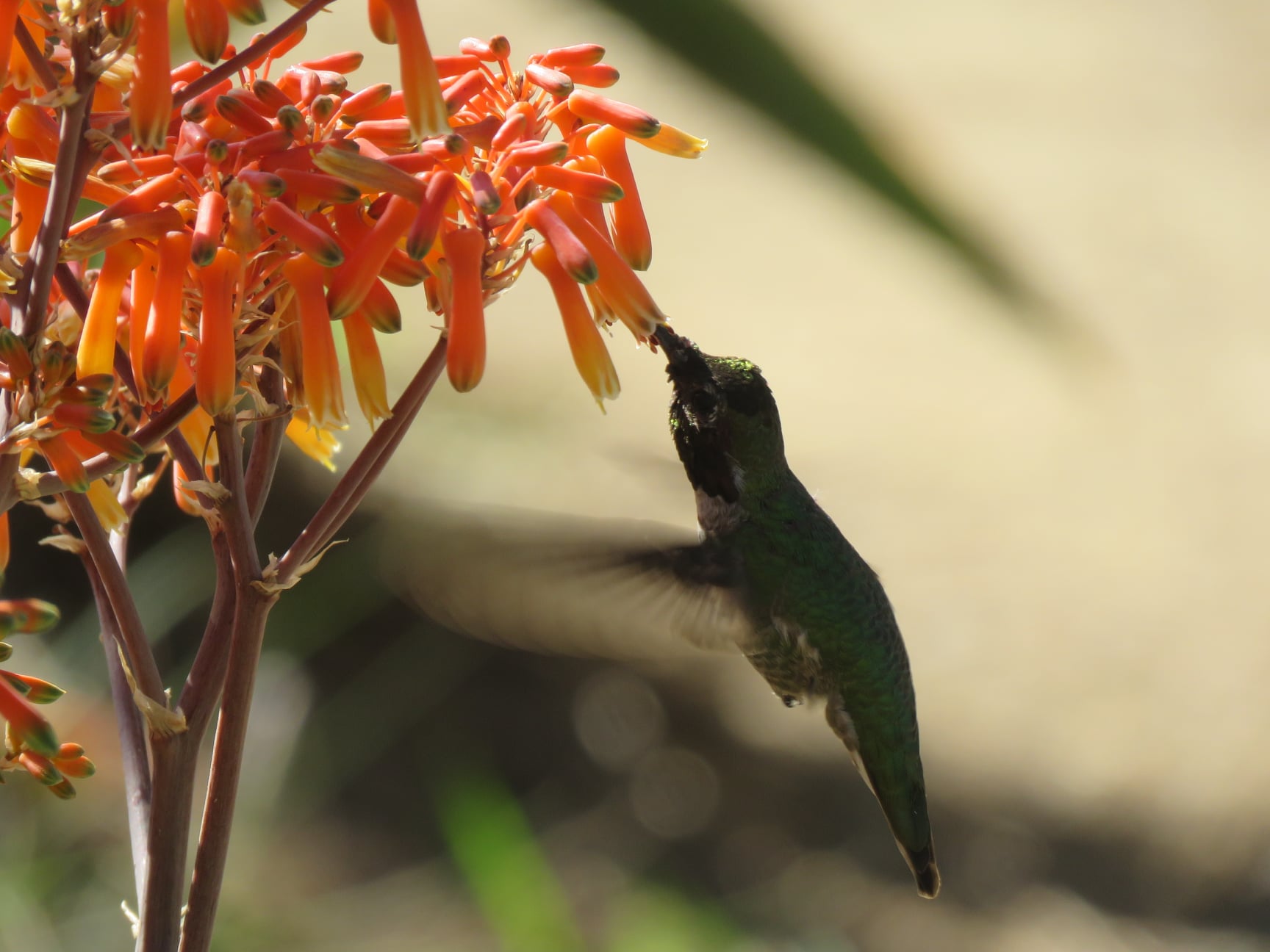
Left: A white-lined sphinx moth (Hyles lineata) visits a red salvia flower (Salvia spp.) in southern Arizona. Right: Sphinx moths often resemble hummingbirds in their hovering style like this Anna’s hummingbird (Calypte anna). [Photos by Rebecca Nelson]
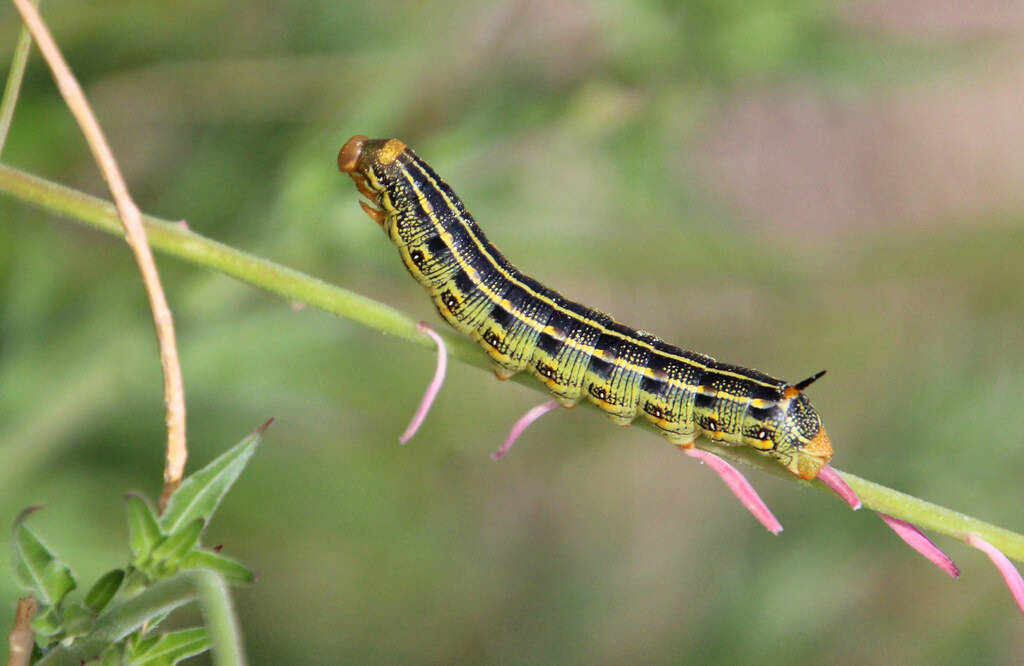
The white-lined sphinx moth is found throughout much of the contiguous United States, including California, as well as in parts of Canada and Central America [2]. They typically produce at least two generations a year between May and September [2]. Their caterpillars are called hornworms and are green with red spots and small horns (see photo below) [2]. The caterpillar has a habit of raising the front of its body in the air in a way that resembles the Great Sphinx of Egypt, hence the name “sphinx moth” [1]. Before metamorphosing, they eat a variety of host plants such as tomatoes and evening primrose [1]. While some other sphinx moth species produce caterpillars that are destroyers of crops, the white-lined sphinx caterpillars are not considered to be major agricultural pests [1–2].
Like bees, birds and butterflies, moths also play an important ecological role as pollinators. The white-lined sphinx moth hums from flower to flower. At each flower, she drinks nectar with her long mouthpart, called a proboscis. As she moves between flowers, she brings pollen with her, helping the flowers reproduce. The white-lined sphinx moth pollinates a diversity of flowers including morning glories (Ipomoea spp.), blazing stars (Liatris spp.), columbines (Aguilegia spp.), plumbagos (Plumbago spp.), thistles (Cirsium spp.), cardinal flowers (Lobelia spp.), evening primrose (Oenothera spp.), and penstemons (Penstemon spp.) [1–2]. The sphinx moth mostly visits flowers at night but will also visit flowers during the day as well [1]. Some flowers have special adaptations to attract sphinx moths as pollinators. They open at night, are long and tube-shaped, have a sweet fragrance and are white in color [3]. The tube shape of the flower is an ideal fit for the moth’s long proboscis, and the white color is easy for her to spot in the dark [3]. Ecologists say that these special flowers have a type of pollination known as “sphingophily”, which is Latin for sphinx-loving [3].
Like many insects, sphinx moths play an important ecological role as pollinators, but they do so differently than other types of pollinators. For example, white-lined sphinx moths are key to primrose (a type of flower) reproduction. Primroses often produce fruits that have seeds from multiple father plants, which puzzled ecologists. Ecologists found that flowers of a rare primrose species in Colorado which were visited by sphinx moths had mated with nearly twice as many father plants than flowers that were only visited by bees [4–5]. Compared to bees, sphinx moths travel further and are thus more likely to distribute pollen from multiple father plants [4–5]. Thus, sphinx moths allow primroses to produce these fruits fathered by multiple plants, more so than other types of pollinators.
Unfortunately, at least one third of sphinx moth species, including the white-lined sphinx moth, in the northeastern United States are declining in population, though the causes remain unclear [6]. Climate change, habitat loss, pesticide use, and light pollution could be contributing to these declines. Planting sphinx moth-friendly plants in your garden or neighborhood (e.g., primroses, morning glories, and columbines) can help provide nectar and habitat. You can use this resource from the National Wildlife Federation to find native flowers for your zip code. The moths will return the favor by pollinating your plants.
Main cover image by Rebecca Nelson
Written by: Rebecca Nelson is a 1st year PhD student in the Graduate Group in Ecology at UC Davis in Dr. Susan Harrison’s lab. She studies how invasive species and restoration strategies affect plant-pollinator interactions. She also writes nature poetry.
References:
[1] Dietz, Jonnie. “Know your native pollinators: White-line sphinx moth.” Florida Wildflower Foundation. https://flawildflowers.org/know-your-native-pollinators-white-lined-sphinx-moth/
[2] “White-lined sphinx moth, Hyles lineata.” University of Wisconsin-Madison, Horiculture, Division of Extension. https://hort.extension.wisc.edu/articles/white-lined-sphinx-moth-hyles-lineata/
[3] Kitching, I. J. (2002). The phylogenetic relationships of Morgan’s Sphinx, Xanthopan morganii (Walker), the tribe Acherontiini, and allied long-tongued hawkmoths (Lepidoptera: Sphingidae, Sphinginae). Zoological Journal of the Linnean Society, 135(4), 471-527.
[4] Rhodes, M. K., Fant, J. B., & Skogen, K. A. (2017). Pollinator identity and spatial isolation influence multiple paternity in an annual plant. Molecular Ecology, 26(16), 4296-4308.
[5] Lewis, E. M., Fant, J. B., Moore, M. J., & Skogen, K. A. (2023). Hawkmoth and bee pollinators impact pollen dispersal at the landscape but not local scales in two species of Oenothera. American Journal of Botany, 110(6), e16156.
[6] Young, B. E., Auer, S., Ormes, M., Rapacciuolo, G., Schweitzer, D., & Sears, N. (2017). Are pollinating hawk moths declining in the Northeastern United States? An analysis of collection records. PloS One, 12(10), e0185683.
[Originally edited by Meredith Lutz]
[Throwback post edited by Alice Michel]
 theethogram.com