Too many legs. It’s just got too many legs. The house centipede – a collection of long, bushy limbs on a striped brown body – is scampering across my floor with a velocity and visage that makes my neck hair stand on end. My eyes dart to the closest object to me – the biology textbook on the table – and I raise the overpriced volume with lethal intent. Time to send this arthropod back to whatever foul pit of Hades it escaped from. But… should I?
A moment’s hesitation, and then it’s too late. The house centipede has effortlessly slipped into some crevice near my bedroom. Great. I’m sure I’ll sleep well tonight.
The house centipede (Scutigera coleoptrata), may strike fear into the hearts of house-dwellers everywhere, but it’s harmless. In fact, these many-legged speed demons do an excellent job in keeping homes free from common pests like cockroaches, bed bugs, silverfish, and termites. Using their unmatched sprinting speed on fifteen pairs of legs, they race down prey in no time flat, incapacitating them with venom before eating them. While it may be tempting to smash them flat, house centipedes can do an excellent job keeping your place pest-free.
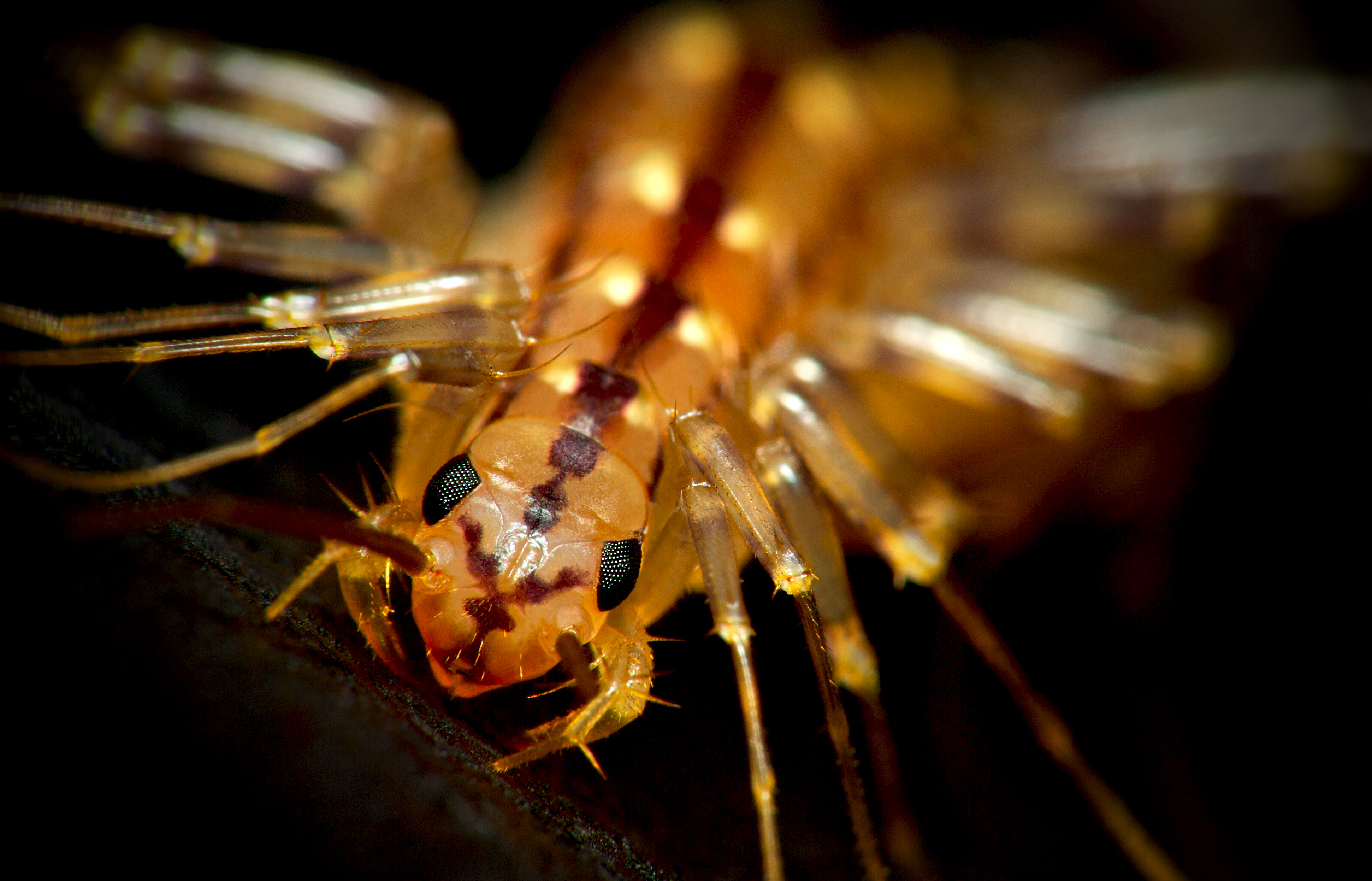
House centipedes prefer damp, dark places, and hunt at night. If you’d prefer to keep them out of your place, consider dehumidifying any damp areas and putting out traps for bugs, the centipede’s food. Otherwise, enjoy the free pest control! Just mind the legs.
Written by: Jacob Johnson is a fifth-year animal behavior PhD candidate at UC Davis studying how animals respond to rapid environmental changes. When he’s not out chasing birds, he enjoys playing jazz saxophone, running board game nights, and writing about nature.
References:
[1] Edgecombe, G. D., & Giribet, G. (2007). Evolutionary Biology of Centipedes (Myriapoda: Chilopoda). Annual Review of Entomology, 52(1), 151–170. https://doi.org/10.1146/annurev.ento.52.110405.091326
[2] Garwood, R. J., & Edgecombe, G. D. (2011). Early Terrestrial Animals, Evolution, and Uncertainty. Evolution: Education and Outreach, 4(3), Article 3. https://doi.org/10.1007/s12052-011-0357-y
[Edited by Jacob Johnson]
 theethogram.com
![[Source]](https://commons.wikimedia.org/wiki/File:HouseCentipedeCloseup.jpg)