The ogre-faced, net-casting spider (Deinopis spinosa) has a terrifying name and what has been described as a “circadian Jekyll and Hyde” lifestyle [1]. They hide during the day, appearing as mere deformities in their home palm trees. As night rolls around, they become fierce predators. Unlike many spiders that build large webs and prey on the mistakes of flying insects, these high-strung arachnids literally take matters into their own hands by fashioning their silk into nets that they hold between their front legs. With this engineering, no nearby insect, walking or flying, is safe.
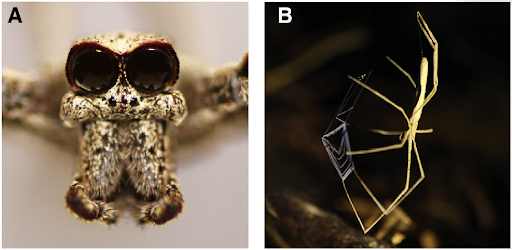
While waiting upside-down, ogre-faced spiders can strike forwards at walking prey or backwards at flying prey. Furthermore, while they need the night vision provided by their two big eyes for spotting food on the ground, they can catch flying prey while blind. Spiders don’t have ears like us, but they have slits and hairs on their arms that can detect vibrations, and some like ogre-faced spiders evidently have complex neural circuitry that can transform those tiny vibrations from wing flapping into the position of their next meal. So, should you be scared of ogre-faced spiders? Unless you are a small flying insect in a tropical forest, I’d say no. Plus, their gigantic eyes make them far cuter than any ogre I have ever seen!
Written by: Brady Nichols is a first-year animal behavior PhD student at UC Davis studying biomechanics and insect ecology/evolution in the Combes lab. He hopes to touch on flight, predator-prey interactions, weather, and paleobiology. Outside of work, he enjoys doing no more than two of the following at a time: birding, biking, cooking, rock climbing, and reading.
References:
[1] Stafstrom, J. A., Menda, G., Nitzany, E. I., Hebets, E. A., & Hoy, R. R. (2020). Ogre-Faced, Net-Casting Spiders Use Auditory Cues to Detect Airborne Prey. Current Biology, 30(24), 5033-5039.e3. https://doi.org/10.1016/j.cub.2020.09.048
[2] Blest, A. D., & Horridge, G. A. (1997). The rapid synthesis and destruction of photoreceptor membrane by a dinopid spider: A daily cycle. Proceedings of the Royal Society of London. Series B. Biological Sciences, 200(1141), 463–483. https://doi.org/10.1098/rspb.1978.0027
[Edited by Jacob Johnson]
 theethogram.com