At first glance, the inky black depths of the ocean seem inhospitable and unwelcoming. The crushing weight of the waters above coupled with the undeniably freezing temperatures seem to serve as an unconquerable obstacle to large forms of life. However, there’s a cetacean species that thrives in these depths. With their ghostly pale faces braving the dark, the Cuvier’s beaked whale (Ziphius cavirostris) call these depths their hunting grounds.
Cuvier’s beaked whale is a member of a family of cetaceans scientifically referred to as Ziphiidae, commonly known as the beaked whales. There are over 22 different species of beaked whales, making it among the largest family of cetaceans, second only to Delphinidae, the dolphin family [1]. Despite their numbers, beaked whales are known for their elusive nature and have left scientists stumped for decades. New species within the family have continuously been discovered within the last two centuries, and among these is the Cuvier’s beaked whale. The first scientifically-recorded sighting of the species was in 1823, credited to its namesake Georges Cuvier [2]. Since then, the Cuvier’s beaked whale has been recorded in oceans around the world.
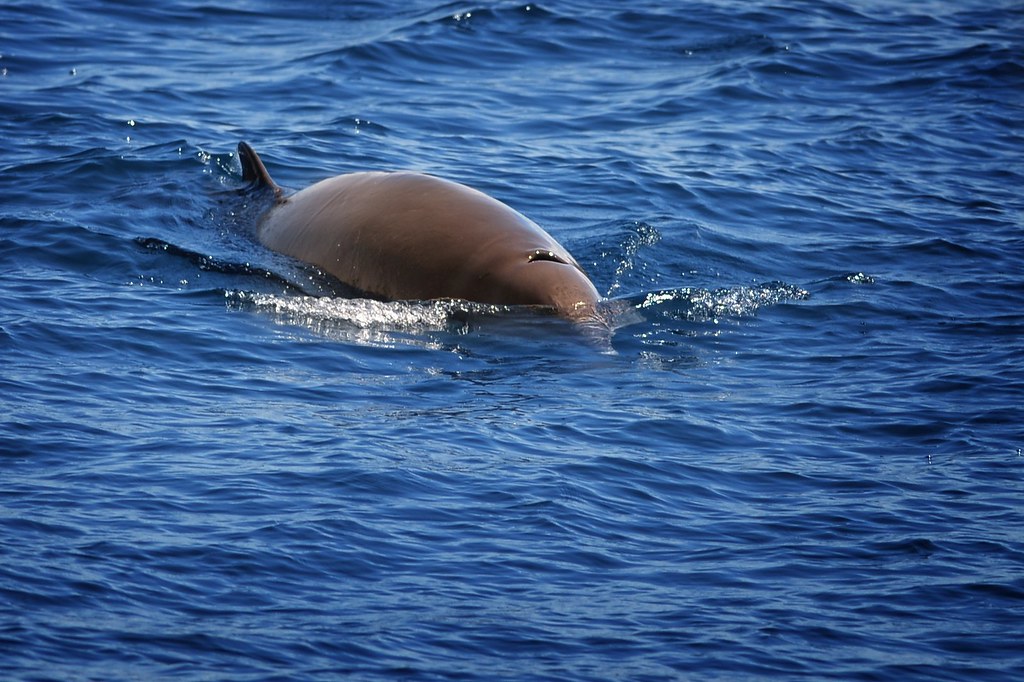
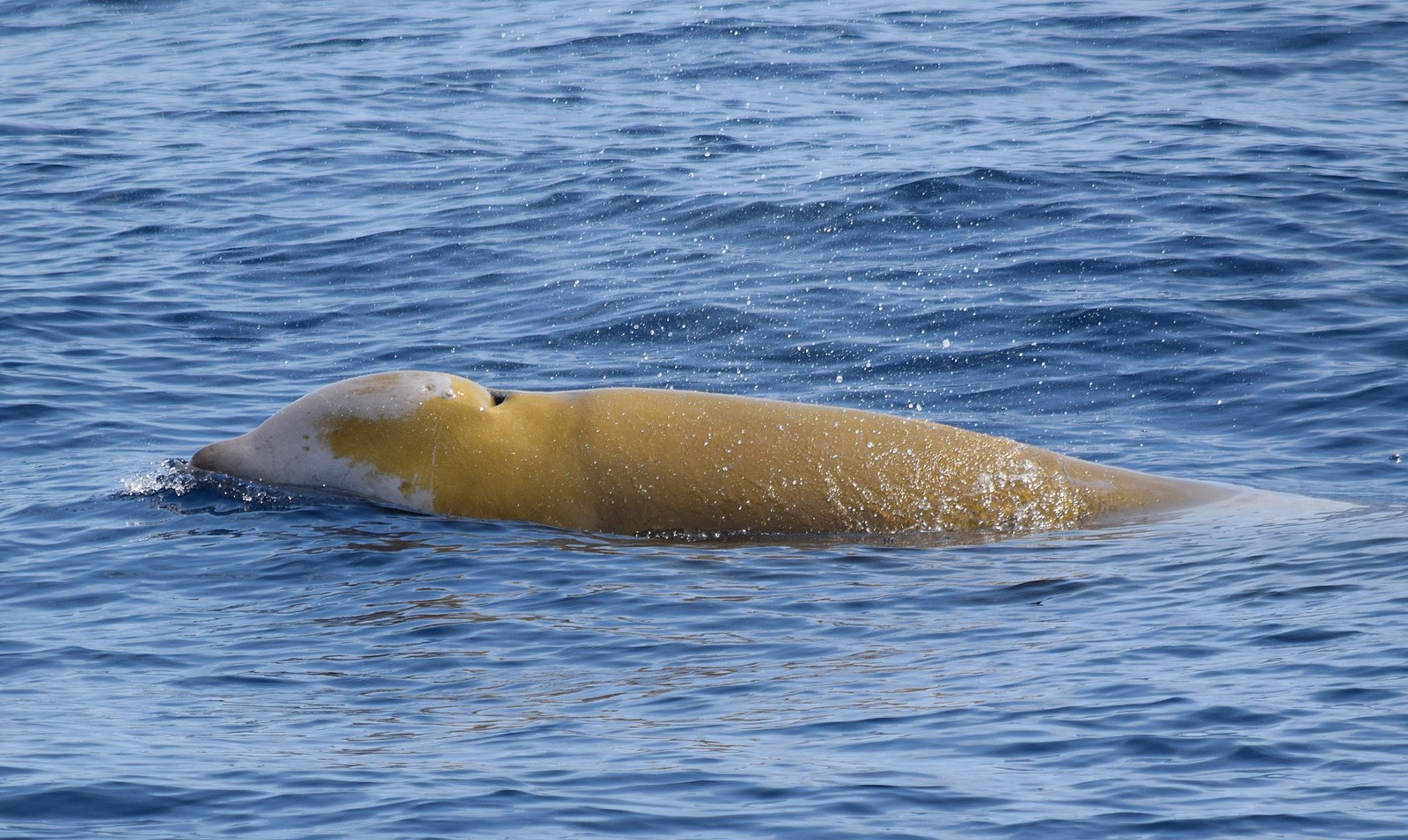
Beaked whales are often incredibly similar in appearance, making their identification at sea a tad difficult. Cuvier’s beaked whale is no exception, sporting a sloping forehead and long snout, or rostrum, which is also referred to as their characteristic beak. Their bodies, about 15-23 feet in length, are dark gray or reddish-brown, with their coloration paling with age [3]. The Cuvier’s beaked whale, however, does have one unique feature: older adults develop dark patches around their eyes that stand out starkly against their white heads. As a result, they’ve earned the name “goose-beaked whale” because of the supposedly goose-like appearance of their heads [3].
From the tropical seas to the open ocean, Cuvier’s beaked whales are among some of the most frequently sighted beaked whales. Despite their wide distribution, little is known about their migratory patterns or behavior close to the surface. Migratory behavior is seen in most whale species aside from the beaked whale, such as baleen whales like the humpback. When it comes to beaked whales, however, data is limited. In fact, genetic studies suggest that Cuvier’s beaked whales don’t migrate at all and instead remain in the same ocean basins for their entire lives [3]. Cuvier’s beaked whales often reside in basin regions characterized by deep waters and prominent geological features. These include underwater canyons, seabanks, and steep-sided underwater mountains known as seamounts [3]. Their preference for deeper waters is tied to their incredible capacity for diving. The Cuvier’s beaked whale, and beaked whales in general, are excellent divers. In fact, the Cuvier’s beaked whale holds the record for the deepest and longest dive for any oceanic mammalian species at 2,992 meters for 137.5 minutes [4]. This is equivalent to about two miles deep for over two and a half hours! Even amongst whales, this is a truly extraordinary feat for any large marine mammal.
The Olympian diving tendencies of the Cuvier’s beaked whale are likely a cause and consequence of their diets and feeding patterns. Like many in the Ziphiidae family, Cuvier’s beaked whales feed largely on various deep water cephalopods like squid and octopi, as well as the occasional fish or crustacean [3]. Cuvier’s beaked whales are capable of locating prey in the dark waters using echolocation – just like bats (such as this species that frequents California) and other cetaceans like river dolphins! – and use species-specific clicking intervals while foraging [5].
Once prey has been located, beaked whales forage using a shockingly toothless mechanism to hunt. Instead of using the band of teeth lining their rostrum, they create an inescapable vacuum using specially designed grooves in the tissue of their throats to suck in their prey [3].
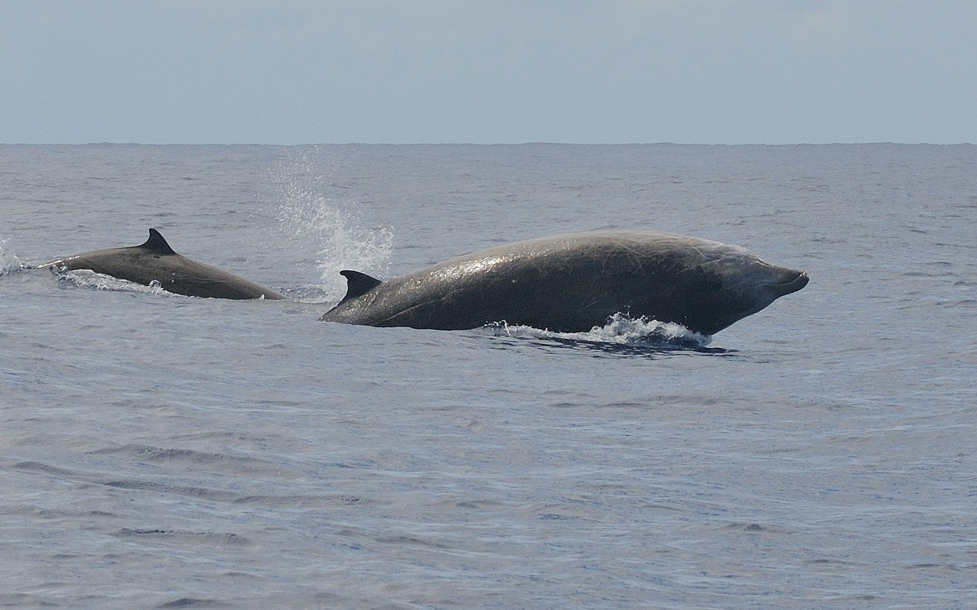
Because Cuvier’s beaked whale, like other cetaceans, are highly reliant on echolocation and auditory cues to hunt and navigate their environment, oceanic noise poses an increasing threat to their survival in the wild. Increased ocean activity from shipping vessels and other boats, as well as the use of sonar in deeper waters can lead to stranding due to disorientation [3]. Beaked whales have also fallen victim to the ever-growing amount of plastic littering the ocean. Whales have been found with the remains of plastic bags in their stomachs, and for species like Cuvier’s beaked whales, these bags prevent regurgitation of cephalopod beaks after consumption [6].
The Cuvier’s beaked whale is a uniquely wonderful oceanic mammal, able to navigate the ocean depths with ease. We can only imagine what other secrets lie below the surface of these elusive cetaceans’ lives.
Cover image by Charlotte Kirchner [Source].
Written by: Emily Corona is a third year undergraduate student studying animal science with a specialization in animal behavior at UC Davis. She has a keen interest in livestock and large animal welfare and hopes to pursue it with her degree. When she’s not studying for the next midterm she loves needle felting, poetry, and cozying up with a good reality TV show.
References:
[1] MacLeod, C. D. (2018). Beaked Whales, Overview. In Encyclopedia of Marine Mammals (Third Edition, pp. 80–83). Elsevier Inc. https://doi.org/10.1016/B978-0-12-804327-1.00062-5
[2] Podestà, M., Azzellino, A., Cañadas, A., Frantzis, A., Moulins, A., Rosso, M., Tepsich, P., & Lanfredi, C. (2016). Cuvier’s Beaked Whale, Ziphius cavirostris, Distribution and Occurrence in the Mediterranean Sea: High-Use Areas and Conservation Threats. Advances in marine biology, 75, 103–140. https://doi.org/10.1016/bs.amb.2016.07.007
[3] National Oceanic and Atmospheric Administration (2023, September 15). Cuvier’s Beaked Whale: Resources. NOAA Fisheries. https://www.fisheries.noaa.gov/species/cuviers-beaked-whale/resources
[4] Schorr, G. S., Falcone, E. A., Moretti, D. J., & Andrews, R. D. (2014). First long-term behavioral records from Cuvier’s beaked whales (Ziphius cavirostris) reveal record-breaking dives. PloS One, 9(3), e92633–e92633. https://doi.org/10.1371/journal.pone.0092633
[5] Warren, V. E., Marques, T. A., Harris, D., Thomas, L., Tyack, P. L., Aguilar de Soto, N., Hickmott, L. S., & Johnson, M. P. (2017). Spatio-temporal variation in click production rates of beaked whales: Implications for passive acoustic density estimation. The Journal of the Acoustical Society of America, 141(3), 1962–1974. https://doi.org/10.1121/1.4978439
[6] Santos, M. B., Pierce, G. J., Herman, J., López, A., Guerra, A., Mente, E., & Clarke, M. R. (2001). Feeding ecology of Cuvier’s beaked whale (Ziphius cavirostris): a review with new information on the diet of this species. Journal of the Marine Biological Association of the United Kingdom, 81(4), 687–694. https://doi.org/10.1017/S0025315401004386
[Edited by Alice Michel & Jacob Johnson]
 theethogram.com

