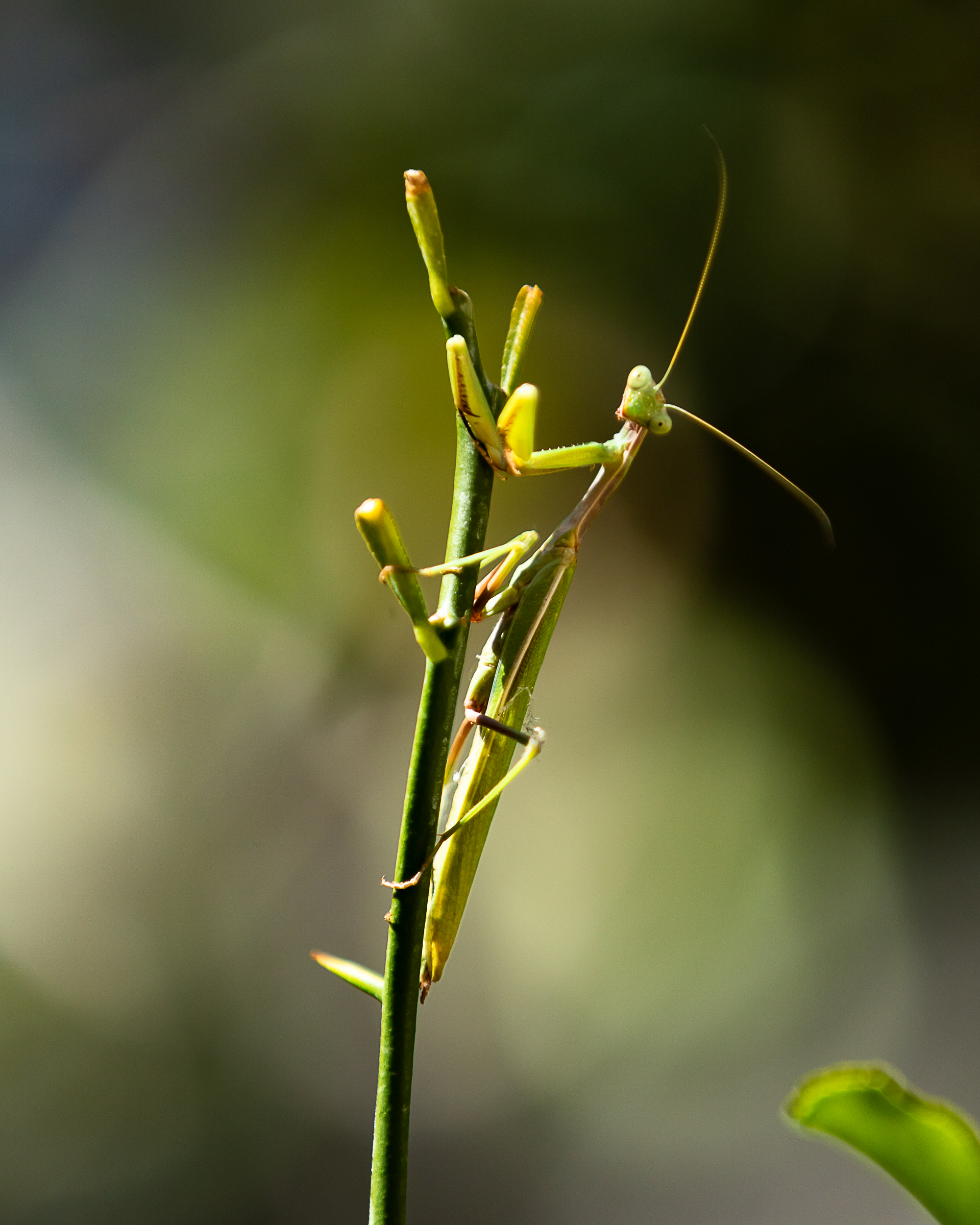
Praying Mantids (Order Mantodea), like this Mediterranean Mantis* (Iris oratoria), are well-known for their awesome predatory strikes and cannibalistic tendencies. Our subject here is doing neither; based on its pupils, it appears to be simply watching the photographer. But wait—surely insects don’t actually have pupils like us… what are those black dots in its eyes? Scientists noticed this similarity too, and thus they are termed pseudopupils. You probably know that insect compound eyes consist of up to thousands of units. These units are called ommatidia, and they appear black when seen head-on because the base of the ommatidium absorbs all the incoming visible light so that the insect can see [1]. If you’ve encountered this effect in person, the pseudopupil may have seemed to follow you… and that’s because it does follow you! But it’s entirely a visual effect on our part, and the insect does not have any control over it. You can recreate a similar effect by looking down through a handful of straws (click here for a great video demonstration)—in the center straws you see shadows towards the other end, but in the rest you can only see the white straw walls [2]. Computer vision researchers, directly inspired by seeing this phenomenon in mantids, have even explored its utility for estimating the three-dimensional poses of objects from two-dimensional images [3]. Next time you’re lucky enough to get close to a mantis (or dragonfly), watch closely and remember that there’s more to their visual systems than meets the eye!
*The editor welcomes identification corrections in the comments.
Photo by Cassidy Cooper; caption by Brady Nichols
Edited by Brady Nichols
References
[1] Zeil, J., & Al-Mutairi, M. M. (1996). The Variation of Resolution and of Ommatidial Dimensions in the Compound Eyes of the Fiddler Crab Uca Lactea Annulipes (Ocypodidae, Brachyura, Decapoda). Journal of Experimental Biology, 199(7), 1569–1577. https://doi.org/10.1242/jeb.199.7.1569
[2] Real Science. (2024, June 29). The Insane Biology of: The Praying Mantis [Video recording]. https://www.youtube.com/watch?v=mDpvHOsXC8g
[3] Bruckstein, A. M., Holt, R. J., Huang, T. S., & Netravali, A. N. (2000). New Devices for 3D Pose Estimation: Mantis Eyes, Agam Paintings, Sundials, and Other Space Fiducials. International Journal of Computer Vision, 39(2), 131–139. https://doi.org/10.1023/A:1008123110489
 theethogram.com