Behold! The ugliest fish in the world. The Blobfish (Psychrolutes marcidus) is renowned for its wide, downturned grin, bulbous nose, and loose skin. But what if I told you that this isn’t its normal appearance? During a 2003 deep-sea expedition off the coast of New Zealand, over 3000 ft below the ocean surface, researchers found the Blobfish looking like your average fish. However, it simply suffered extreme decompression damage when transported to the surface due to the pressure change, resulting in its notorious appearance [1]. The reason why these fish decompress so much more than other deep-sea fish is because, unlike most fish, they don’t have a skeleton! They belong to the family Psychrolutidae, all members of which have skeleton-less, scaleless, gelatinous bodies [1]. The common name for the family is “fathead sculpin,” which refers to the large, round head and flabby skin of these fishes [5]. Just like the description, blobfish naturally have a large head that tapers into a small, flat tail, and a body about 30 cm long [8]. In addition to their odd appearance, they perform interesting behaviors, such as being lie-and-wait predators and reproducing in groups [3].
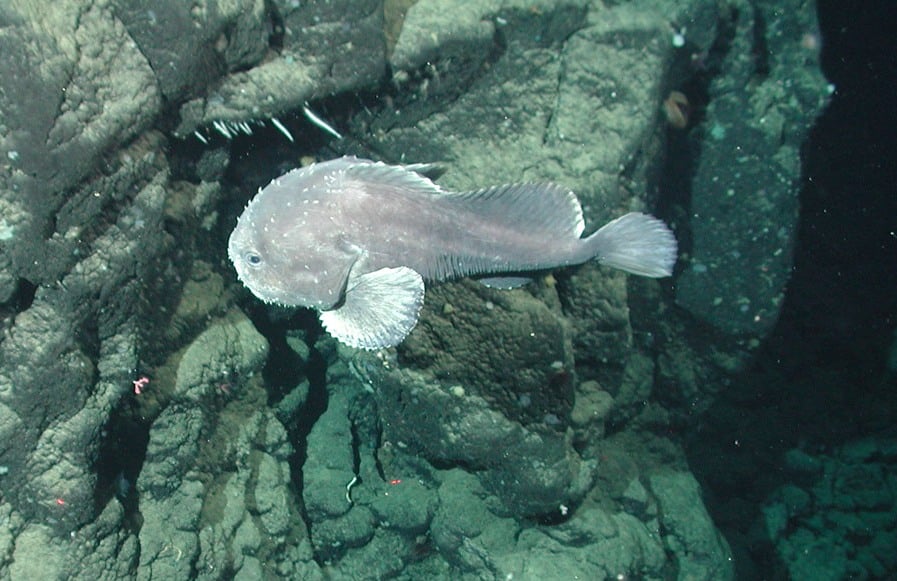
Blobfish inhabit the waters of Australia, Tasmania, and New Zealand at depths of 2,000 to 4,000 feet. At this depth, no light penetrates, and few other animals live. To survive under these circumstances, blobfish are opportunistic eaters. Their bodies are less dense than water, allowing them to drift above the seabed, passively eating any organic matter that floats down from the surface, such as small crustaceans, anemones, and decaying animals (carrion) [2, 3]. Once they detect prey near their mouth, they quickly swallow the unsuspecting creature whole, as they have no teeth [8]. This style of hunting, called lie-and-wait predation, is an adaptation to their living conditions, as chasing around prey would cost too much energy in a habitat where there is no light [8]. Unlike most fish, blobfish lack a swim bladder, which helps fish control their buoyancy underwater. That’s because the deep-sea pressures would cause any organ filled with air to implode! Instead, their high fat and water content – essentially, their blobbiness – allows them to withstand this pressure [3]. The lack of air sac allows the fish to withstand pressure 100x stronger than we humans feel at sea level [3]! They also rely on the surrounding pressure to maintain their shape as they have soft bones and very little muscle. In addition to relying on the surrounding environment to maintain their shape, they use the pressure to passively move while exerting little energy as their bodies are less dense than water [8].
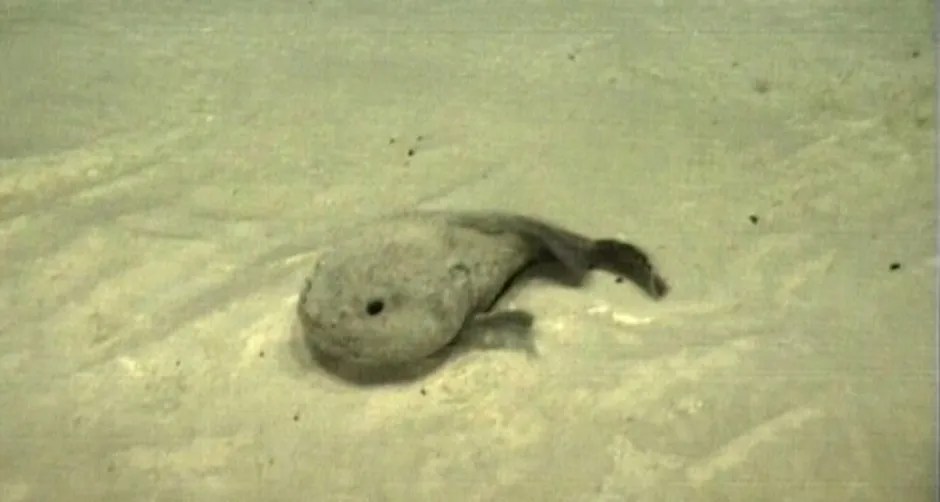
Blobfish participate in group reproduction because they inhabit waters where finding a mate is too energetically costly and risky for their survival. Female blobfish lay large clutches of about 100,000 eggs on plateaus in rocky areas and remain close to the nest, tending to them while they mature [3 & 7]. It has been recorded that female blobfish will nest next to each other, but the reasoning behind it is not fully understood [7]. On the other hand, the male’s job is just to swim near the egg cluster, release their sperm, and then leave as they do not participate in post-fertilization care [9].
Due to the blobfish’s deep-sea home, they are relatively new to the scientific community, only being discovered in 2003, and little is still known about them. However, scientists can make some assumptions about their basic biology based on related deep-sea fish. For example, it’s estimated that they can live up to 130 years based on the life expectancy of their close relative, the blob sculpin (Psychrolutes phrictus) and the Australian sculpin (Psychrolutes occidentalis) [6, 7, & 10]! While the blobfish doesn’t have any known predators, they are threatened by human activities such as deep-sea fishing and bottom trawling, during which a fish net is dragged along the seafloor [3].
While the blobfish may be considered an “ugly” creature, it has remarkable adaptation to the deep-sea life. Their gelatinous bodies and unique physiology enable them to live in an environment where most other animals cannot. However, the threat of human activities makes it crucial to raise awareness and implement sustainable fishing practices to protect these creatures and the ecosystems they inhabit.
Main featured image by Kerrn Parkinson [Source].
Written by: Rowisa Valarao is a fourth-year undergraduate student studying animal science, specializing in companion and captive animals at UC Davis. She is interested in companion and shelter animals hoping to pursue a career in the healthcare field with her degree. In her free time, she loves working out at the ARC, rewatching her favorite movies or TV shows, and trying new places to eat or drink caffeine.
References:
[1] Parks, J. (2024). With a Comically Sad Face, the Blobfish Could be the Ugliest Animal in the World. Discover Magazine. https://www.discovermagazine.com/planet-earth/with-a-comically-sad-face-the-blobfish-could-be-the-ugliest-animal-in-the
[2] Franz Lidz. (2015). Behold the Blobfish. Smithsonian; Smithsonian.com. https://www.smithsonianmag.com/science-nature/behold-the-blobfish-180956967/
[3] National Geographic. (2022). Blobfish, facts and information. Animals; National Geographic. https://www.nationalgeographic.com/animals/fish/facts/blobfish
[4] O’Hare, P. (n.d.). What Is a Blobfish? The Lovably Ugly Fish. Earth.com. https://www.earth.com/earthpedia-articles/what-is-a-blobfish-the-lovably-ugly-fish/
[5] News, O. H. (2023). Blobfish (aka Mr Blobby). The Australian Museum. https://australian.museum/learn/animals/fishes/fathead-psychrolutes-aka-mr-blobby/
[6] Island Bay Marine Education Centre. (2020). Blobfish Facts. Island Bay Marine Education Centre. https://octopus.org.nz/content/blobfish-facts
[7] Laboratory, F. (2023). Blobfish: Adaptation as a Deep Sea Fish & More. Fish Laboratory. https://www.fishlaboratory.com/fish/blobfish/
[8] Taylor, I., & Pester, P. (2023). Blobfish: Facts about the world’s ugliest animal. Www.sciencefocus.com. https://www.sciencefocus.com/nature/the-blobfish-a-bloated-guide-to-the-worlds-ugliest-animal
[9] How does a blobfish have babies? – brainly.com. (2023). Brainly.com. https://brainly.com/question/38394592
[10] Blobfish. (2023, March 14). AZ Animals. https://a-z-animals.com/animals/blobfish/
[Edited by Jacob Johnson]
 theethogram.com
![[Source]](https://commons.wikimedia.org/wiki/File:Psychrolutes_phrictus_2.jpg)
![[Source]](https://c02.purpledshub.com/uploads/sites/41/2021/03/Blobfish-in-water-b448d13.jpg?webp=1&w=1200)
![[Source]](https://octopus.org.nz/sites/default/files/users/user18/Blobfish.jpg)