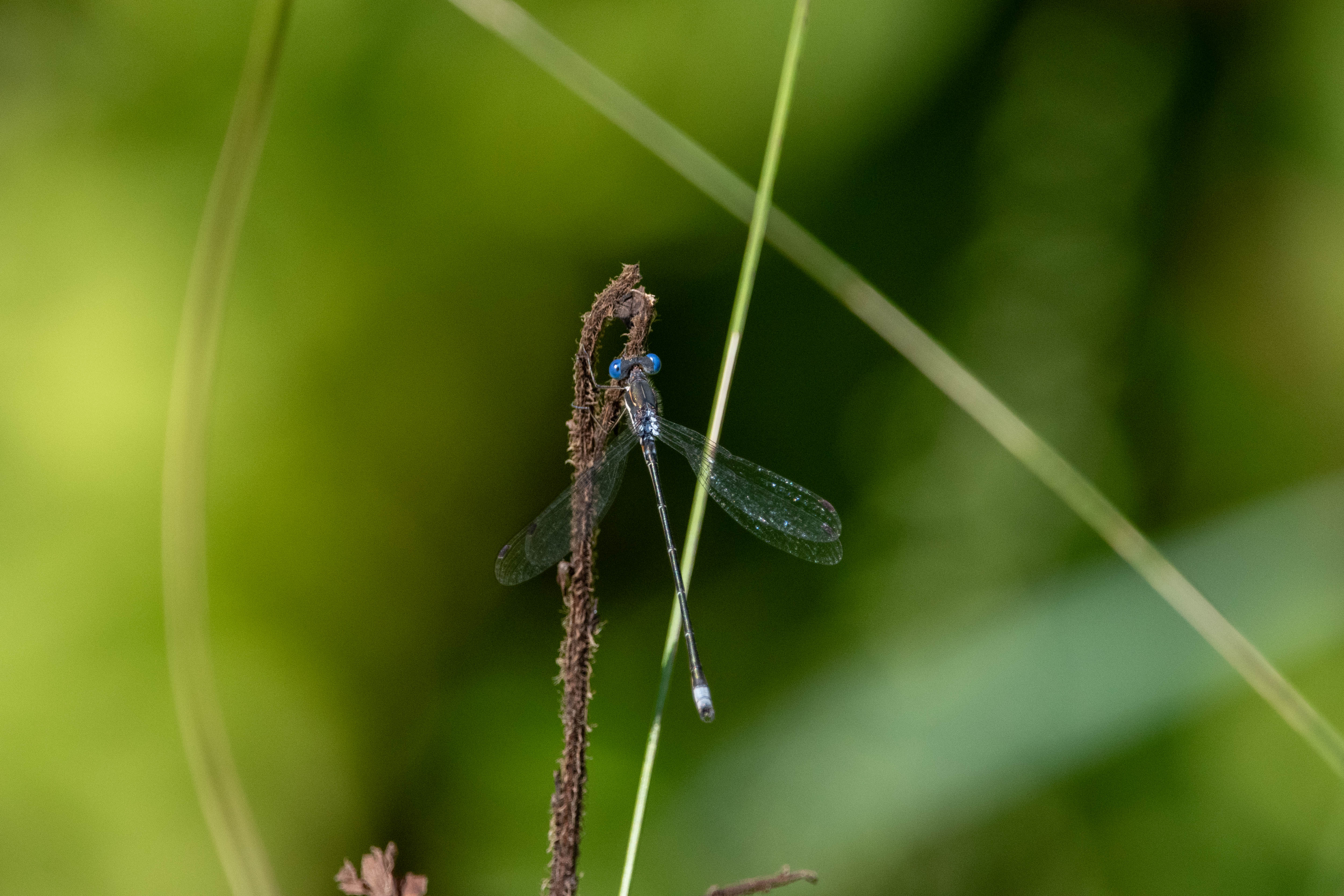
When I first explain to kids at summer camp that damselflies exist and are different from dragonflies, I typically just tell them that dragonflies perch with their wings spread apart, while damselflies perch with their wings together over their back. This is very often the case indeed, but if one of my summer camp kids were to see this photo, they would immediately mis-identify this organism as a dragonfly. This damselfly happens to be a member of the one damselfly family that perches with spread wings—the so-called spreadwings (Lestidae). Then how else would you be able to tell it is a damselfly? The scientific name of the damselfly suborder gives us one clue: damselflies fall in suborder Zygoptera, and dragonflies are in suborder Anisoptera (and they both fall in the order Odonata). The suffix “-ptera” means wing, and the prefixes “Zygo-” and “Anis-” respectively roughly mean “forming a pair” and “unequal”. As it turns out, the fore and hind pairs of dragonfly wings are different shapes, while the fore and hind wing pairs of a damselfly are almost identical (as is clear here). You could also just look at the shape of the wings in general—while dragonfly wings are widest at the base and taper, damselfly wings are petiolate, which is to say they have a little stalk just like a leaf. It’s not yet known how exactly this confers a benefit in flight, but it’s thought to contribute to their hovering and general aerial acrobatics abilities being better than dragonflies in some instances. Next time you see an odonate scooping up prey and eating it mid-air, or plucking something off the surface of the water while narrowly avoiding drowning itself, try to get eyes on its wings—that’s where all the magic happens.
Photo and caption by Brady Nichols
Edited by Brady Nichols
 theethogram.com