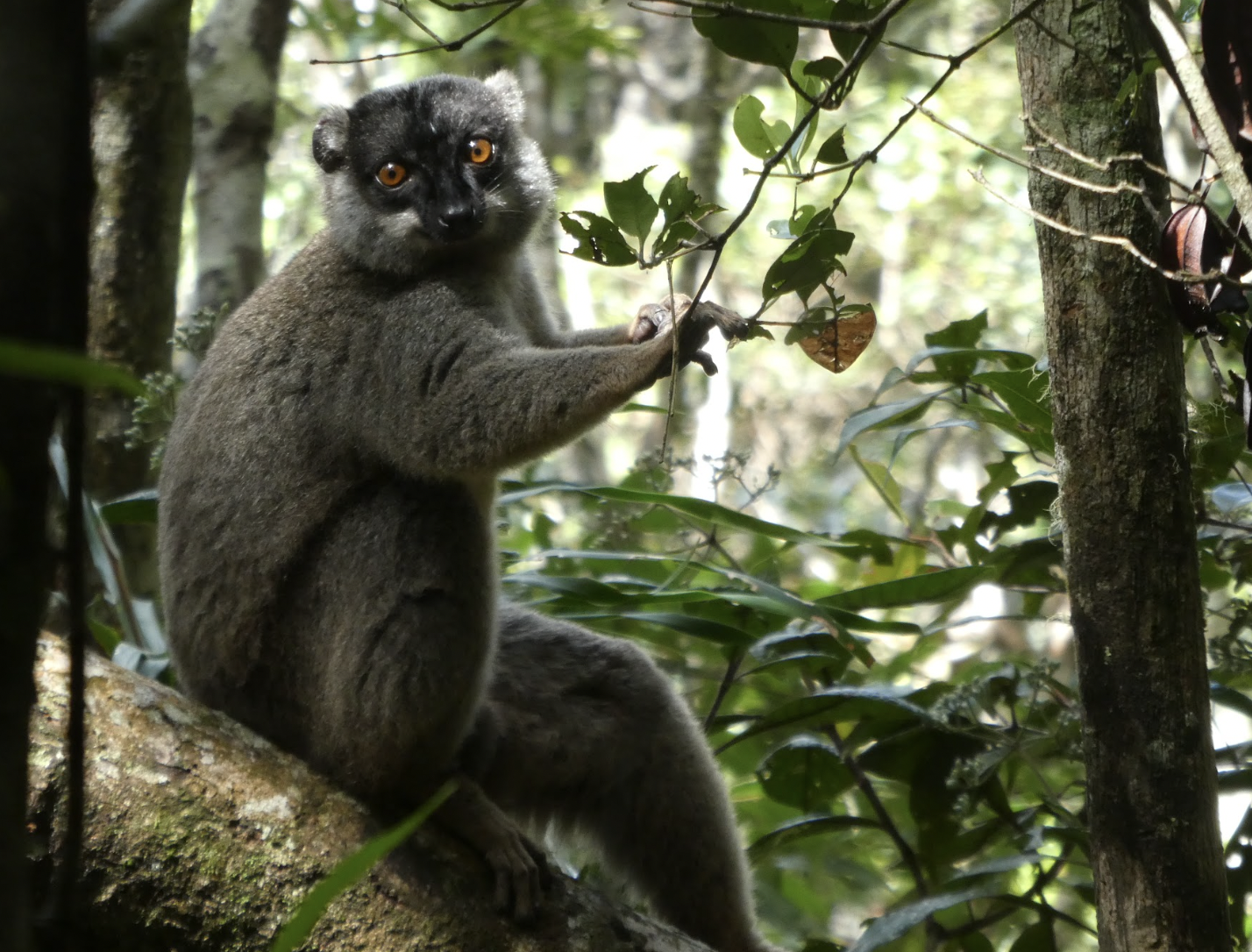
The red-fronted lemur (Eulemur rufifrons), native to Madagascar, was once a subspecies of the brown lemur but is now considered a species on its own. Like many other lemur species, they are arboreal, meaning that they can often be found in trees, leaping from branch to branch. Their name comes from a unique patch of red fur around their face, which in part serves to help them identify other individuals of their own species in situations where they live near other lemur species. Researchers came to this conclusion by presenting a variety of lemur species first with a photo of a conspecific (one of their own species), then an individual from another species, and found that lemurs spent more time looking at and sniffing photos of the conspecifics, indicating some recognition. The experiment also raised some interesting questions about if sexual selection played a role in determining these facial patterns, and if the lemurs’ sniffing indicates that they use other modes of recognition in addition to just sight.
Photo by Meredith Lutz; Caption by Isabelle McDonald
Edited by Brady Nichols
References
Rakotonirina, H., Kappeler, P. M., & Fichtel, C. (2018). The role of facial pattern variation for species recognition in red-fronted lemurs (Eulemur rufifrons). BMC evolutionary biology, 18, 1-10.
 theethogram.com