Domestic cats and bears both belong to the order Carnivora.
Bears have an incredible sense of smell — for instance, black bears may be able to detect scents from 1 to 2 miles away. This powerful ability helps them locate food across great distances.
Cats, can rotate their ears 180 degrees to better detect prey. This precise directional hearing allows them to pick up even the faintest sounds, aiding in hunting. They have 32 muscles in each ear, compared to just 9 in humans.
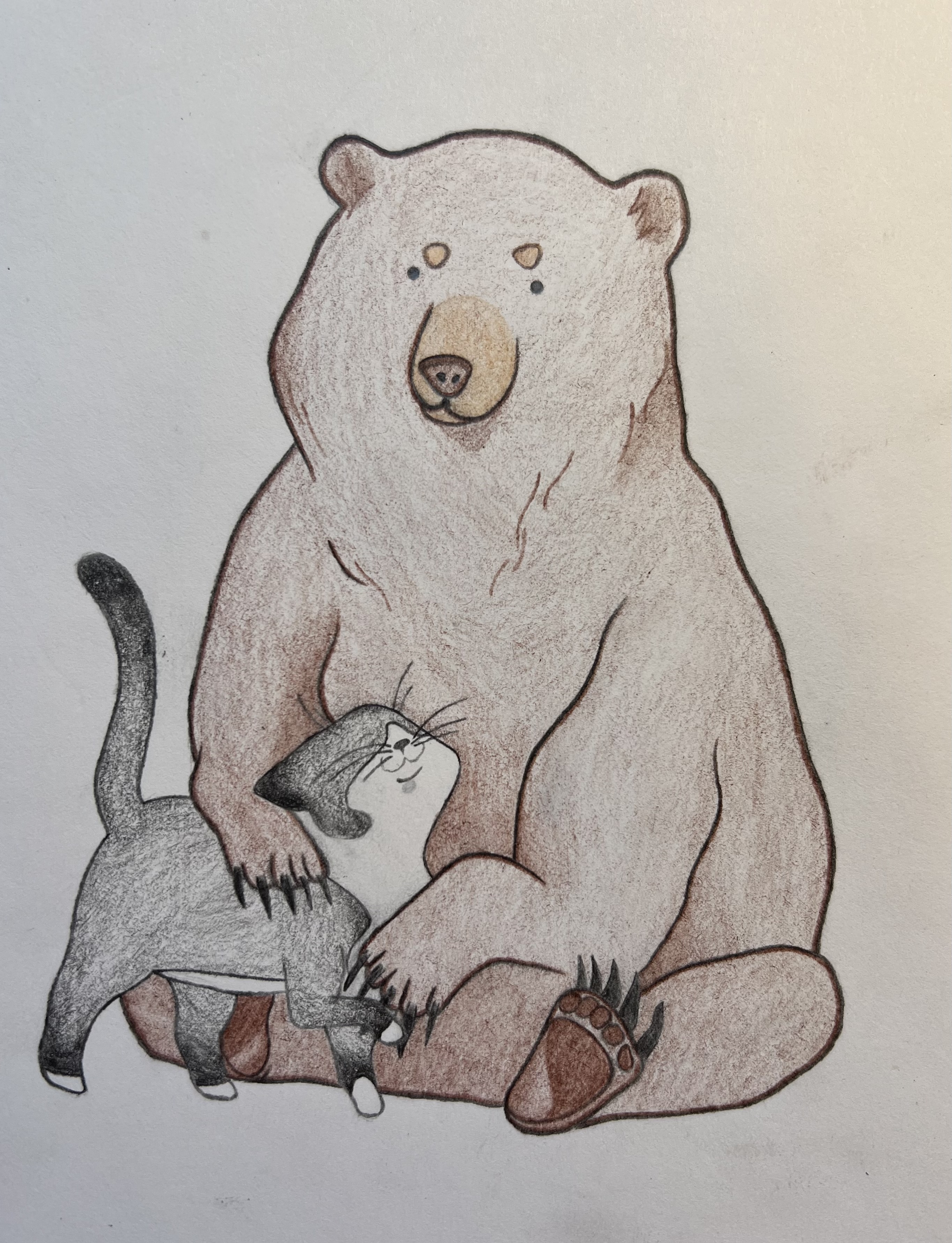
Art and fact by Kristina Leslie, Instagram @tinaleslie_
[Edited by Nicole Rodrigues]
Reference:
Agnarsson, I., Kuntner, M., & May-Collado, L. J. (2010, March). Dogs, cats, and kin: A molecular species-level phylogeny of Carnivora. Science Direct, 54(3), 726-745. https://doi.org/10.1016/j.ympev.2009.10.033
JG – Park Ranger (Yosemite Valley). (2014, October 1). Bear Series, Part One: A Bear’s Sense of Smell. National Park Service. Retrieved May 29, 2025, from https://www.nps.gov/yose/blogs/bear-series-part-one-a-bears-sense-of-smell.htm
Cliffin, G. (2023, March 1). Why Do Cats Put Their Ears Back? Cats.com Retrieved May 29, 2025, from https://cats.com/why-do-cats-put-their-ears-back#:~:text=Cats%20can%20rotate%20their%20ears,noises%20made%20by%20their%20prey.
 theethogram.com