When I park the ATV at the top of a hill and the drone of the engine cuts out, a hush settles over the foothills. Removing my thick helmet, I can finally hear the fluting of distant meadowlarks. To my west rises a long, wide ridge of granite cliffs. I’ve been scanning this ridge on my ascent up a rutted two-track, but there are almost too many good spots to check for eagle nests here, since the gray rock is cracked and fissured along its entire face, forming numerous pockets and ledges. To my east lies a green valley rimmed with the peaks of the snow-capped Owyhee Mountains. The valley is dotted with junipers and jagged cliffs of volcanic rock that cut like daggers out of the rolling hills. I start by scanning these scattered cliffs with my spotting scope, and make note of an old stick nest on a distant cliff, last used by eagles several years ago. It is empty again. Despite being huge birds with huge nests, eagles have a way of vanishing into these wide landscapes.
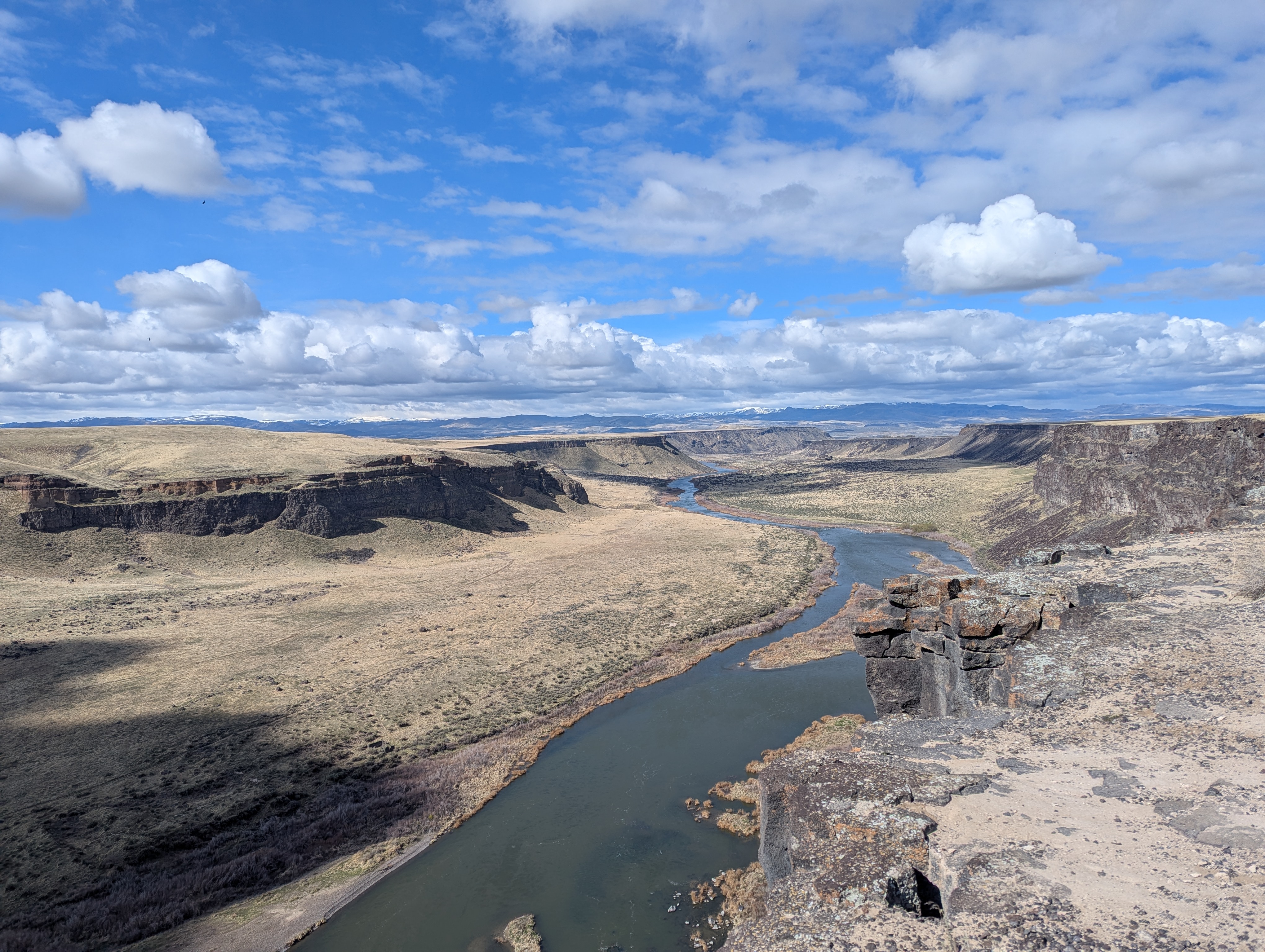
Photo Source: Sam Hagler
On a scan through the valley, I spot the wide dark wings and golden nape of a soaring golden eagle, which disappears behind a hill directly to my east. With no other leads to follow, I hike eastward over the hills, skirting bushes of lupine with young silvery flowers. As I climb over a rise, a hidden band of cliff appears below me, carved out of the hillside. There, between columns of reddish rock, an adult golden eagle bends down over a stick nest, fussing with something at its feet. When the adult takes off, I see a lamb-white downy nestling staring back at me with large, dark eyes.
As a research technician with Boise State University this season, I get to immerse myself in the lives of nesting golden eagles. For the first part of the season, I spend my days exploring the foothills and canyonlands of southwestern Idaho in search of eagle nests. I love this kind of work. Surveys and behavioral observation are two strengths of mine, practiced over multiple seasons of nest surveys. There is comfort in doing familiar work, but surveys are only one part of our field season, and what comes next is much more daunting for me.
There are lots of research questions about nesting golden eagles that you can answer with a good vehicle and a spotting scope, but there are some questions that require going over the edge of the cliff yourself. Biologists at Boise State University have been surveying for eagles and climbing to nests for years to understand how eagle populations are changing over time. Surveys help the team understand changes in territory occupancy and breeding success across the population, but climbing to nests helps us see each eagle family under a closer lens. Climbing to nests is the only way for us to band nestlings, collect genetic samples, and study the diseases and parasites that are making it harder for nestlings in southwestern Idaho to survive to fledging age.
Without wings, we need to rappel down from the top of the cliffs. The rest of my crew are all experienced climbers, and they make this look easy. I have done most of my field work with both feet on the ground, and my limited climbing background is primarily with trees, so I took this job with equal parts excitement and apprehension knowing that one way or another, I would finally push myself to become a stronger climber.
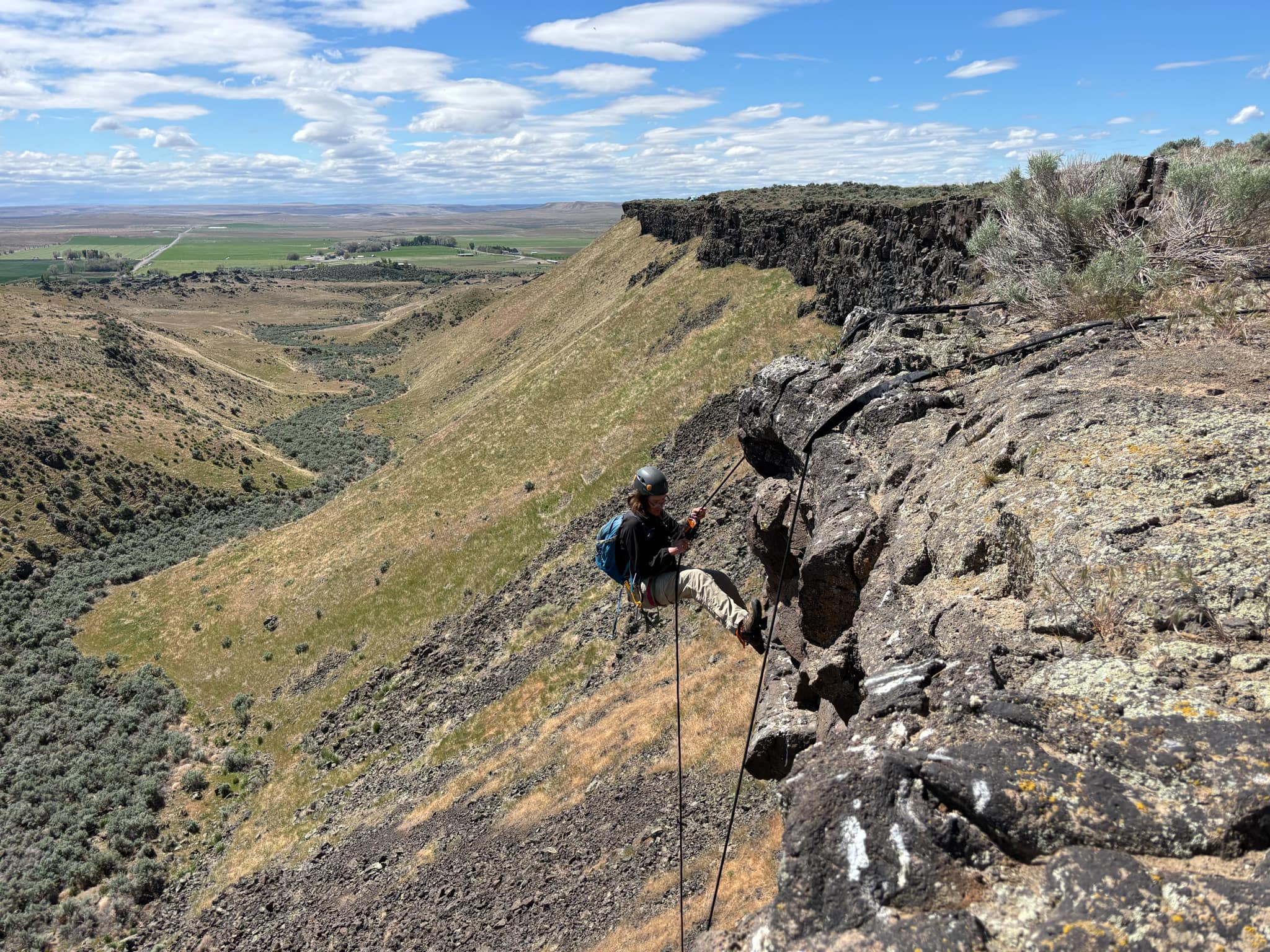
Photo Source: Sam Hagler
Reality doesn’t quite sink in until I find myself one day standing at the top of a crumbly basalt cliff in the Snake River Canyon for my first real climb of the season, leaning back in my harness with a black rope stretched taut in front of me and the open sky at my back. Far below this cliff, a line of locust trees traces a small creek that feeds into the teal ribbon of the Snake River. I have a soft-sided black pet carrier slung over my shoulder, and inside it is a three-week-old eagle nestling. We have just finished banding it, and now I need to return it to its nest some forty feet below us, closer to the ground than to the top of the cliff. I lean back, pull back the handle of my gri-gri (a self-belaying device) to allow the rope to run through it, and tiptoe my way backwards over the edge. Small chunks of rock break loose underfoot and crackle off the cliff wall as they tumble to the ground. I inch my way down the ledge, shifting weight slowly between my legs and my climbing harness. Balance is key. Although my feet are planted wide against the vertical rock face to brace each tiny step, my legs are shaking. Stepping back over the edge is the hardest part. Once I bring myself low enough to pin my rope firmly against the rock at the top of the ledge, I can take a deep breath, sit more easily in my harness, and descend. I rappel past alternating bands of dark and light rock, as if I am climbing through millions of years of geological time, until finally the stick nest is right below me.
An eagle nest is a different world. I smell it as I drop into the center, pungent with the sweet scent of feathers and decay from prey remains. The nest is built with a foundation of large grayish-brown sagebrush branches forming a tall, messy woven cylinder. A carpet of thinner, golden brush forms the cup of the nest. The bright red of bloody mammal limbs, orange shafts of northern flicker feathers, and green sprigs of sagebrush brighten the browns and golds. It is hard to comprehend the size and density of these nests until you’re standing in one, even one like this that is newly built this season. Many eagle nests are reused frequently, added to year after year until they form towering mounds of sticks; some were even constructed decades ago when this study first began. This one still has the looser, brushier feel of a new build, but it is large enough and strong enough that I could easily sit in it, even lay down in it.
I lower myself until I am almost sitting in the nest, then reach into the carrier at my side and gently lift the eaglet, who flaps its wings and opens its beak in protest. I plop the nestling back into its nest. It shuffles its way closer to the rock wall with wings open, then settles down, until the only motion I see is the swish of its nictitating membrane as it watches me. I wish I could stay and wait here and watch the light slant across the cliff as the sun drops towards the hills, but I know my ascent will be slow and I need to get started. Still, it’s hard not to feel proud and giddy with the strangeness and beauty of entering an eagle’s world, even just for a few minutes.
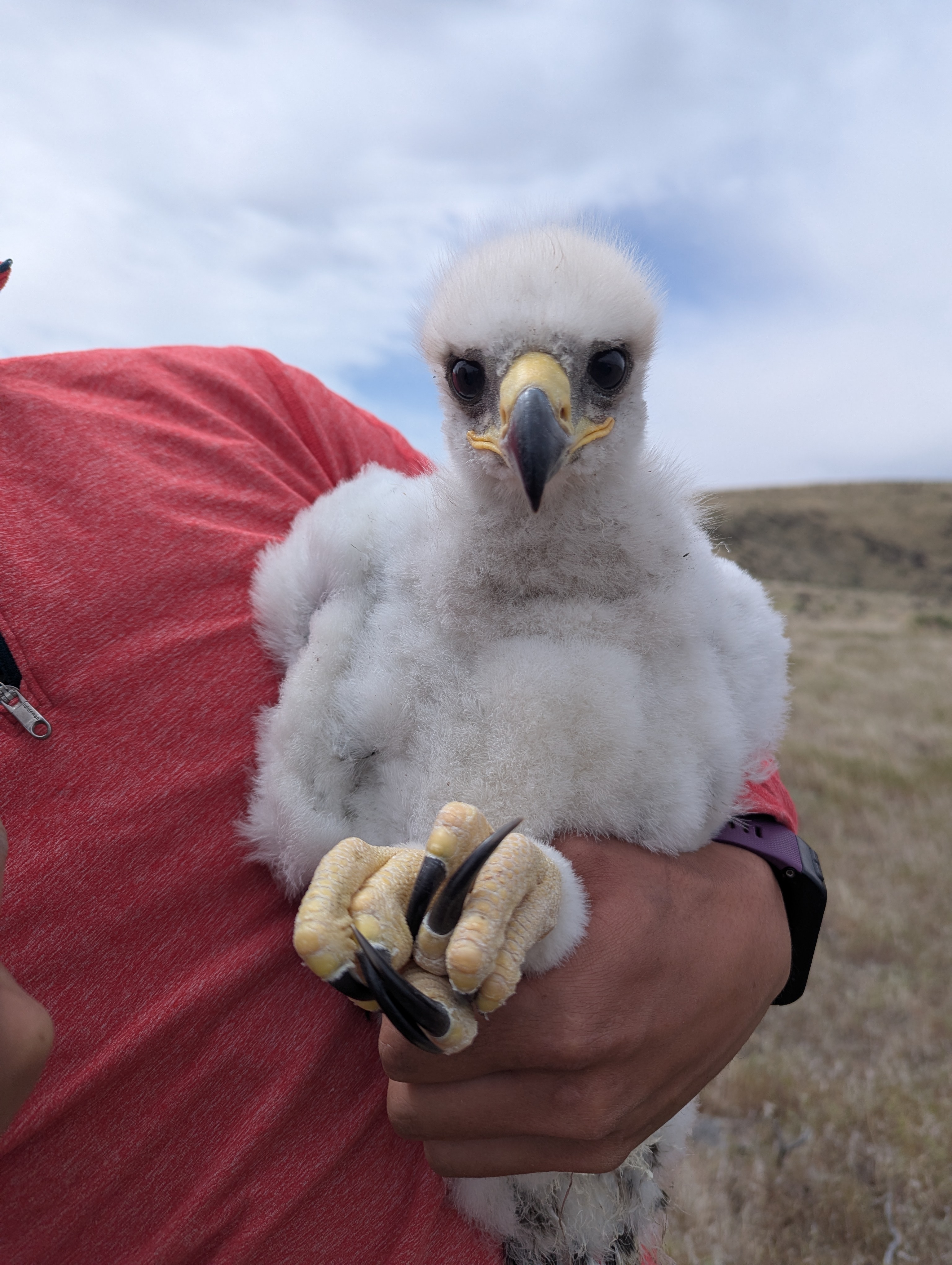
Photo Source: Sam Hagler
After a couple months of climbing into nests, it can still be hard for me to go over the edge, but knowing I can do it is a great feeling. Learning a new skill like this on a field project can feel vulnerable and challenging, especially with a crew who already knows the ropes, but it’s also been a wonderful opportunity to grow. My reward is getting to see this part of Idaho as only a bird sees it. Learning a new skill this way makes me feel a bit like an eagle nestling— I may not have wings, but building my confidence on rope is my own way of fledging.
Sam Hagler (she/her) is currently working as a seasonal research technician with the Raptor Research Center at Boise State University. She is an incoming PhD student in the Department of Ecology and Evolutionary Biology at Princeton University. Her research interests include behavioral ecology and evolution, raptor biology, and parasitology.
[Edited by Clay Jones]
 theethogram.com