Harlin/Hayley Steele (they/she/ze/he) stayed in a cabin in the California wilderness during the early days of the COVID-19 lockdown. Through the window, they observed this member of the weasel family, which they say “looks like a ferret and bounces like a squirrel, but with actual rhythm.”
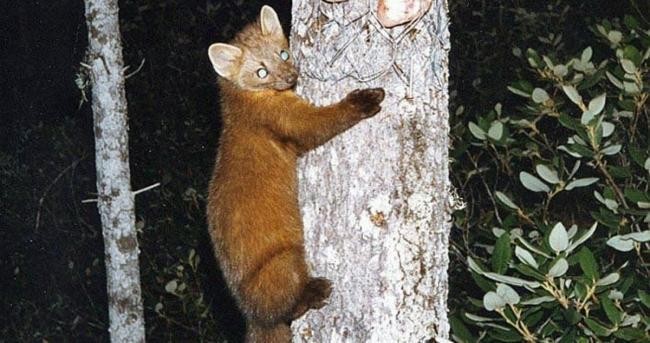
As they describe, “I’d never seen an animal move quite like that. Its long little body would arch like a rainbow and then dive to align with the shape of the terrain. My brain registered it as water at first: brown, fuzzy water bouncing down the hillside. Only when I looked more carefully did I register that this was actually a graceful little animal.”
When ze went back to grading papers on their laptop, ze glanced down and saw that the marten had somehow entered the cabin. It stood on its hind legs next to Steele, staring with the same curiosity Steele had had earlier. A minute or so later, Steele spotted it outside again, bouncing back up the hillside.
Until that moment, Steele had no idea this sort of animal existed. He searched wildlife websites until they found a photo of the creature who had visited. “This funny little rascal had gone to the trouble of coming all the way into the cabin to get noticed; learning its name was the least I could do. Since then I’ve had a special place in my heart for Pacific martens.”
Steele wondered how Pacific martens were doing as a species. So, he looked them up in the Living Planet Index, a part of Our World in Data, a project of the UK’s Global Change Data Lab. The Living Planet Index traces the population sizes of over 10,000 animals around the world and distills those data into a single metric to measure changes in biodiversity. He downloaded a file with data for martens, but it appeared to reference a different species of marten, the American marten (Martes americana), rather than the Pacific marten (Martes caurina).

Still, they thought they might learn something from the American marten data. “After all, according to some researchers from the Beaty Biodiversity museum in Vancouver, the Pacific marten and the American marten have many similarities, including shared habitat and taxonomy.” However, no data have been collected for the species since 1992, when the species’ numbers wobbled around 1500 or fewer creatures. “According to one of the authors who gathered these data, it is probable that the American marten will either go extinct, or experience quasiextinction (20 females remaining), in the next 500 years [1]. Yikes!” says Steele.
After some digging, Steele found the species profile for the Pacific marten on the U.S. Fish and Wildlife Service’s website, where the word “threatened” appears highlighted in bold orange letters. In 2024, the U.S. Fish and Wildlife Service included the Pacific marten on a list of 59 species that they are especially worried about [2]. Although not good news for the Pacific marten, Steele found the fact that researchers were at least tracking the species reassuring.
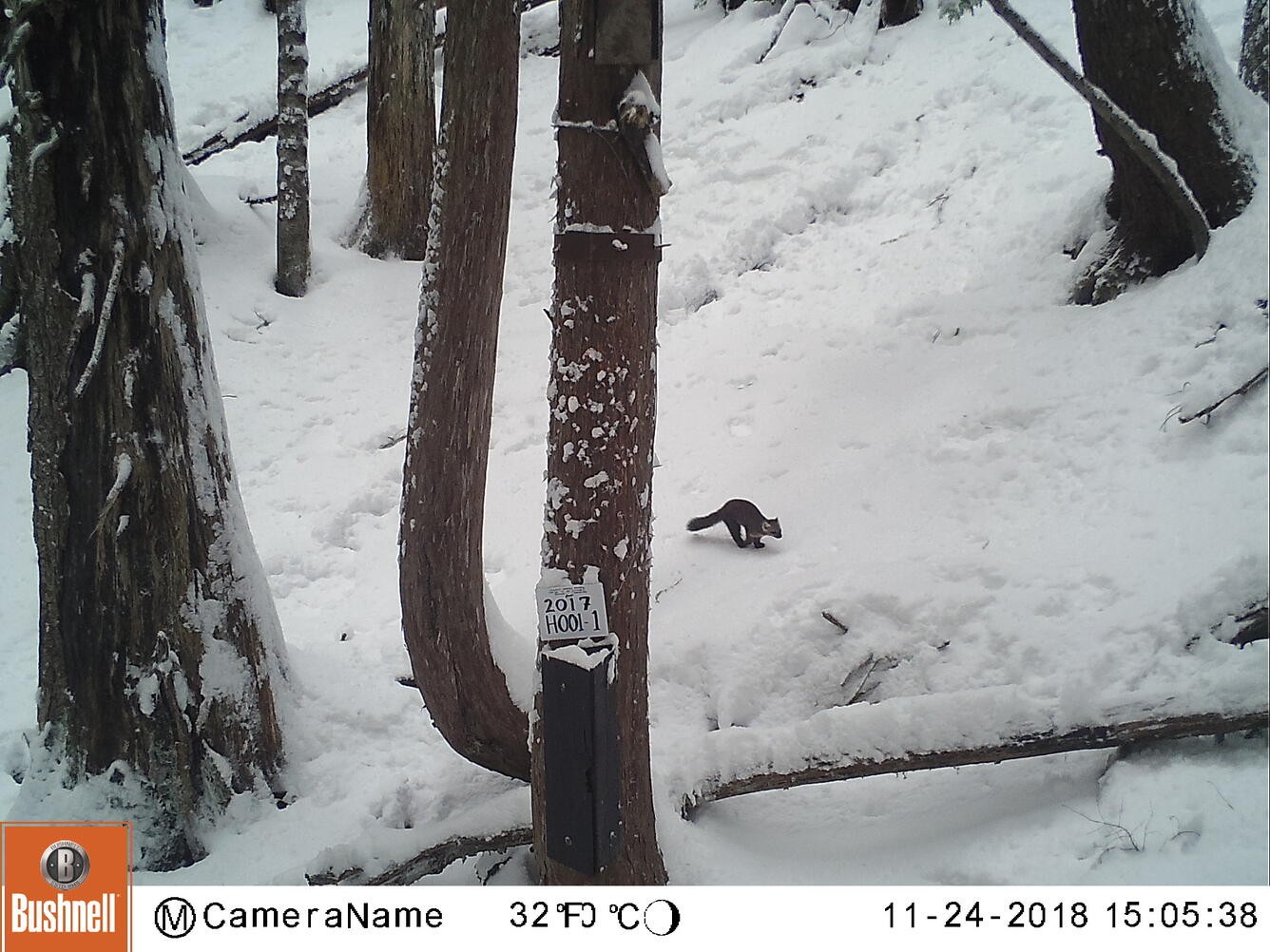
Other local Northern California species are also listed there as currently endangered or threatened, including the San Joaquin kit fox, three species of kangaroo rat, birds, reptiles, butterflies, and a whole page of plants. Steele says, “Anyone who lives in the American west would do well to spend a little time with this list. Take a moment to look up pictures of these plants and animals. All of them are currently at risk of being lost forever.”
However, Steele’s sense of relief at finding the Pacific Marten on the US Fish and Wildlife Service’s site faded away when they remembered the DOGE cuts. The U.S. Fish and Wildlife Service experienced massive firings due to “DOGE cuts” in early 2025 [3]. This has led many of their major assessments to grind to a halt.” So, the Pacific marten may very well be in danger of extinction, but we might not get to know about it, because the very people who make that assessment just had their offices gutted,” says Steele.
Steele says that journeying into the data deepened zir relationship with the mysterious fuzz ball who visited zir. “My life has been enriched simply by knowing a little more about that little creature that moved me on a day that would have otherwise felt quite bleak. I share a planet with this creature, after all. This is like a way of getting to know your neighbors.”
This research expedition did give Steele an incentive to consider reaching out to her representatives to ask that they continue to fund research to track the well-being of the Pacific marten and the other 59 endangered or threatened species on the list. “I assumed that Pacific martens were crawling all over the place after my close encounter with one. If an animal you care about is dwindling, you gotta get loud to make sure the animal isn’t lost forever. If the animal’s population isn’t being tracked, all the more reason to get loud!” Steele hopes that others do similar research into the global and local populations and well-being of other wild animals, starting with the Living Planet Index and then moving to other data sources when needed.

A Pokemon fan since childhood, Steele says if we can learn ‘stats’ for hundreds of fictional animals, we can do the same for real world creatures. She imagines that if everyone kept track of just one wild animal species, we could sound the alarm much sooner when a specific species is under threat.
This could involve participating in existing citizen science initiatives, such as those led by iNaturalist, or doing research on our own, as Steele did. The Species Monitoring Specialist Group provides a list of global data sources and information on species abundance and biodiversity. “Let’s be good neighbors. In the case of animals, that means being nosy neighbors. Keeping an eye on how animal species are doing is a kind of surveillance I can support!”
Cristina Deptula (cedeptula@sbcglobal.net) is a UC Davis alumna and former content writer for the College of Engineering. She’s currently a freelance science and tech writer, with pieces published by Yale’s School of Medicine, TrooRa Magazine, and the SF Bay Area climate resilience publication KneeDeepTimes.
Harlin/Hayley Steele is a PhD Candidate in Cultural Studies at the University of California Davis, with a dual designated emphasis in Performance and Practice and STS (Science and Technology Studies). They received their MFA in Creative Writing from Portland State University in 2014. Ze is also a Lead Narratologist at BasedMIP and a researcher at the Feminist Research Institute.
[Edited by Cassidy Cooper and Clay Jones]
References:
[1] Schneider, R. R., & Yodzis, P. (1994). Extinction dynamics in the American marten (Martes americana). Conservation Biology, 8(4), 1058-1068.
[2] United States Fish and Wildlife Service, Interior. “Endangered and Threatened Wildlife and Plants; Initiation of 5-Year Status Reviews for 59 Pacific Southwest Species.” Federal Register, vol. 89, no. 200, 16 Oct. 2024.
[3] Jones, Benji. “US Fish and Wildlife Service Has Halted Critical Conservation Funding.” Mother Jones, 19 February 2025, https://www.motherjones.com/politics/2025/02/us-fish-wildlife-service-conservation-funding-freeze-pause-endangered-species-animals/. Accessed 12 December 2025.
 theethogram.com