I know what you’re thinking, “What a cute nose!” As you might expect, most proboscis monkey females would give this guy a 10/10, and for good reason. His big nose is considered a highly desirable feature in a mate. Yet, there is so much more to him than his good looks!
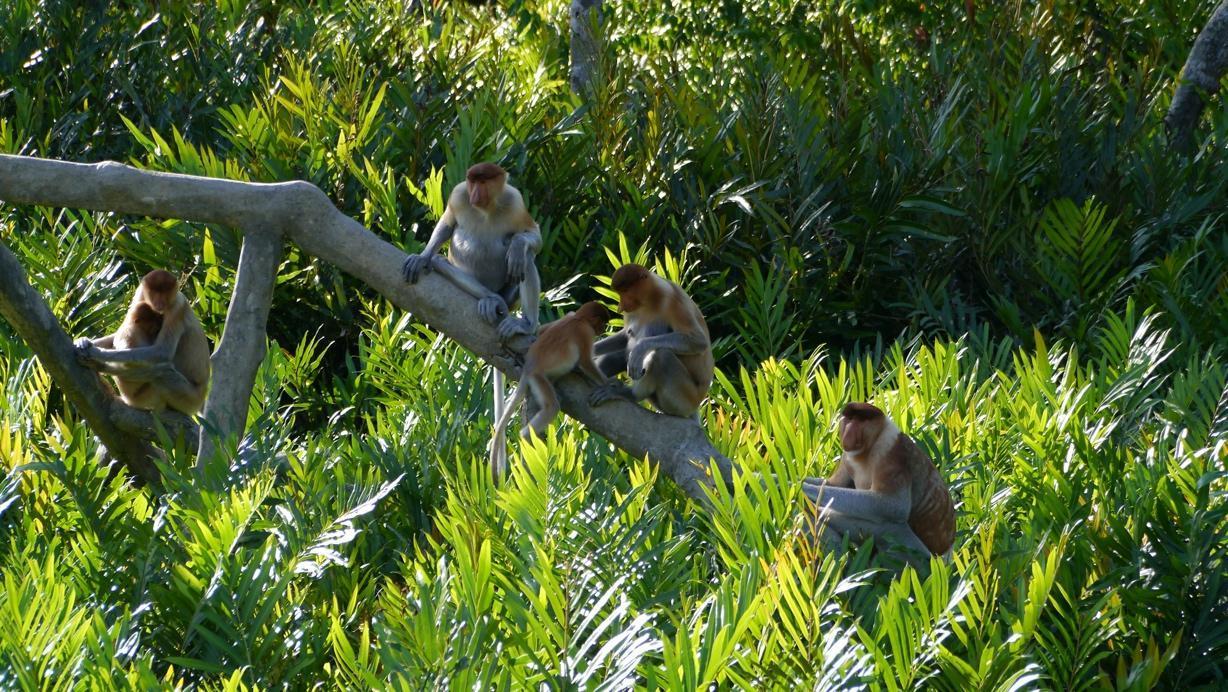
You can find proboscis monkeys (Nasalis larvatus) in the rainforests of Borneo, a tropical island divided among the countries of Indonesia, Malaysia, and Brunei. They live in ‘harems’ of one dominant male, several females, and their direct offspring [1]. Neighboring groups of monkeys join together at night to form bands of 60 members, but they separate into smaller groups to forage during the day [2].
Proboscis monkeys are picky eaters and require water plant species that contain large amounts of minerals (e.g., calcium, potassium, iron, and zinc) which aid in digestion [3] and protein synthesis [4]. In fact, their dietary regimen is so difficult to replicate in zoo settings, that proboscis monkeys often cannot survive nor breed in captivity [3]. They love to eat fruits and leaves and sleep in trees adjacent to these food sources in case they want a midnight snack [5]. They have multi-chambered sacculated (saclike) stomachs to ferment leaves and break down cellulose, giving them a pot-bellied look. However, they boast a facial feature that sticks out even more.
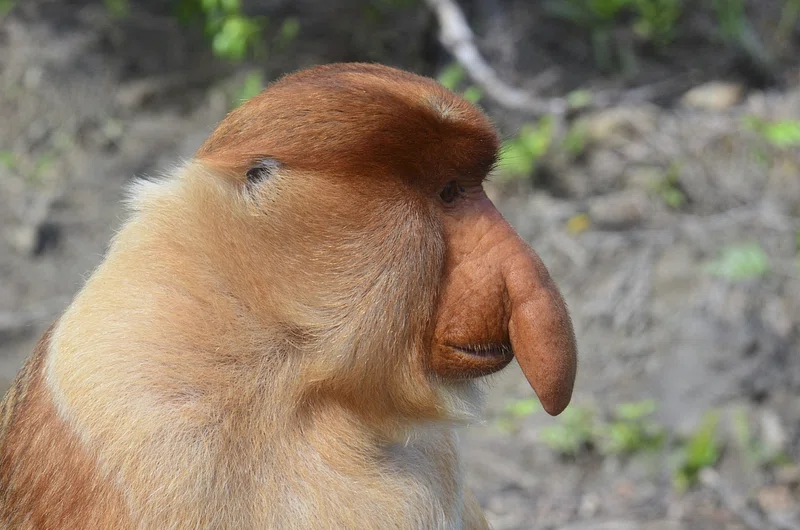

At left, an adult male proboscis monkey [Source] and, at right, a conspecific adult female [Source].
Male proboscis monkeys have the largest nose out of any primate, with humans taking second place, losing by just a nose. As their name implies, a ‘proboscis’ is any long and flexible protruding facial appendage, such as an elephant’s trunk, or a tapir’s snout. In this case, female choice—leading to sexual selection—produced the male proboscis monkey’s attractive schnoz. In fact, the size of a male’s nose is directly correlated to the number of females in his harem [6]. There are several possible reasons why this could occur:
Large nasal passageways act as a trumpet to amplify vocalizations which impresses females and intimidates males [6] (check it out on Youtube)! Likewise, nose size has a positive correlation with testes size, meaning more sperm and a higher likelihood of fertilization [6]. Finally, a large nose is coupled with a large body, thus more physical strength to fight off predators and compete with rival males who want to overtake their group [6]. However, instead of slapping each other around with their floppy noodle noses, harem takeovers between males are surprisingly nonaggressive [1]. A series of threats and honks occur and the females simply follow the better mate, granting him access to their territory [1].
Prime proboscis monkey real estate is within 0.5 miles of a water source, such as coastal mangrove forests, swamp forests, and riverine forests [4]. As an adaptation to inundated environments, they are the Olympic divers and swimmers of the nonhuman primate world, wooing human spectators with their miraculous performances. They use the treetops as diving boards to bellyflop themselves into the water from several meters high, seeking food on the other side of waterways. Even new mothers jump; their infants have to cling on tight!
Once they stick their landing, proboscis monkeys use their partially webbed fingers and toes to doggy paddle through the water. All this splashing and commotion attracts predators such as crocodiles who are lurking around, waiting for a snack. Yet, land is arguably not any safer, since leopards, sun bears, snakes, and even eagles can attack them from every angle [7]. Despite the abundance of predators in their habitat, it is human activities that pose the biggest threat.
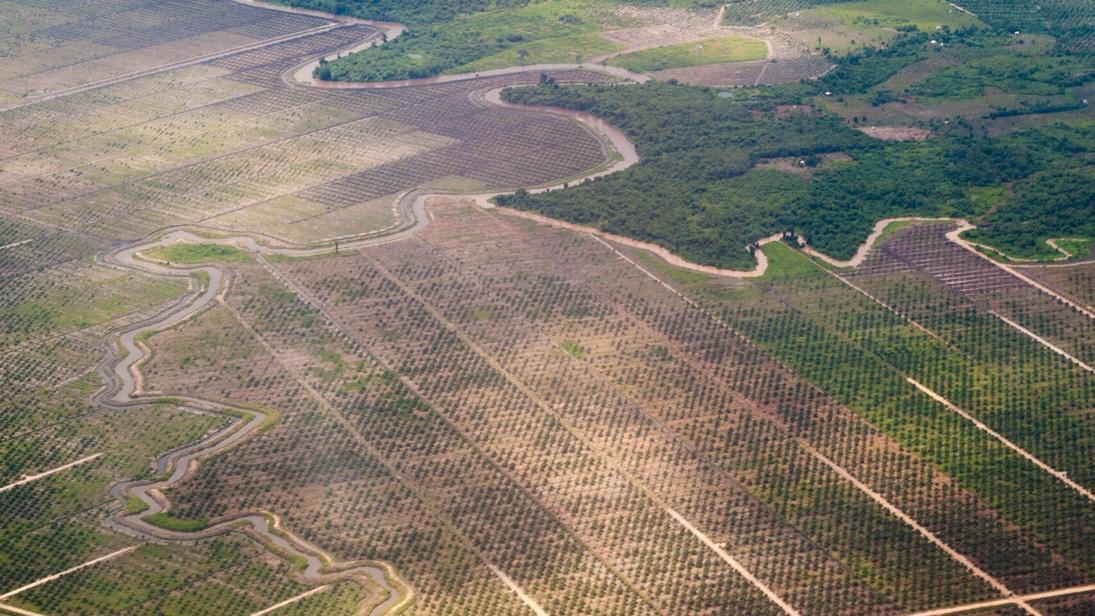
Forest conversion into palm oil plantations is responsible for drastic declines in the number of proboscis monkeys and isolates populations from one another [3, 4]. In fact, habitats are so fragmented and mating prospects so few, it is possible that some proboscis monkeys have started to mate with silvery luntung monkeys, creating a new hybrid species [8]. Indeed, this ‘mystery monkey’ has intermediate limb proportions and coloration between the two species, and surprisingly appears to be fertile due to swollen breasts, suggesting lactation [8]. Despite these harmful effects, palm oil is here to stay due to its economic importance and versatility.
Palm oil is edible, virtually tasteless, moisturizing, heat-resistant, and can help mix several ingredients together. For these reasons, it is used in everyday items such as soap, ramen noodles, pizza dough, chocolate, and shampoo. Fortunately, if we research which products use sustainably grown palm oil or avoid it altogether, we can help our peaceful, endangered, and funny-looking proboscis monkey friends continue their legacy.
I hope you enjoyed learning about this fascinating species and gained appreciation for one of our closest living relatives, the nonhuman primates! Stay nosy.
[Featured image source]
Written by: Brad Christin is a PhD student in the Department of Anthropology at UC Davis who studies sustainable development in the Republic of the Congo. He aims to relate his work to the conservation of gorillas, chimpanzees, and other primate species. When he’s not studying, he likes to ride his bike and go to the beach!
References
[1] Murai T. 2004. Social behaviors of all-male proboscis monkeys when joined by females. Ecological Research, 19(4):451-4.
[2] Bennett, E. L., & Gombek, F. (1993). Proboscis Monkeys of Borneo. Kota Kinabalu.
[3] Agoramoorthy, G., Alagappasamy, C., & Hsu, M. J. (2004). Can proboscis monkeys be successfully maintained in captivity? A case of swings and roundabouts. Zoobiology, 23(6), 533-544.
[4] Bismark, M. (2010). Proboscis monkey (Nasalis larvatus): Bio-ecology and conservation. Indonesian Primates, 217-233.
[5] Yeager, C. P. (1989). Feeding ecology of the proboscis monkey (Nasalis larvatus). International Journal of Primatology, 10, 497-530.
[6] Koda, H., Murai, T., Tuuga, A., Goossens, B., Nathan, S. K., Stark, D. J., Ramirez, D. A., Sha, J. C., Osman, I., Spiangkui, R., & Matsuda, I. (2018). Nasalization by Nasalis larvatus: Larger noses audiovisually advertise conspecifics in proboscis monkeys. Science Advances, 4(2), eaaq0250.
[7] Feilen, K. L., & Marshall, A. J. (2014). Sleeping site selection by proboscis monkeys (Nasalis larvatus) in West Kalimantan, Indonesia. American Journal of Primatology, 76(12), 1127-1139.
[8] Lhota, S., Yap, J. L., Benedict, M. L., Ching, K., Shaw, B., Angkee, B. D., Lee, N., Lee, V., Mao, J., & Ruppert, N. (2022). Is Malaysia’s “mystery monkey” a hybrid between Nasalis larvatus and Trachypithecus cristatus? An assessment of photographs. International Journal of Primatology, 43(3), 513-532.
[Edited by Jacob Johnson and Alice Michel]


_female_Labuk_Bay.jpg)
Excellent article! Thank you for sharing these photos and important information
LikeLike